
Moon Mission Astronauts to Serve as Living Science Experiments
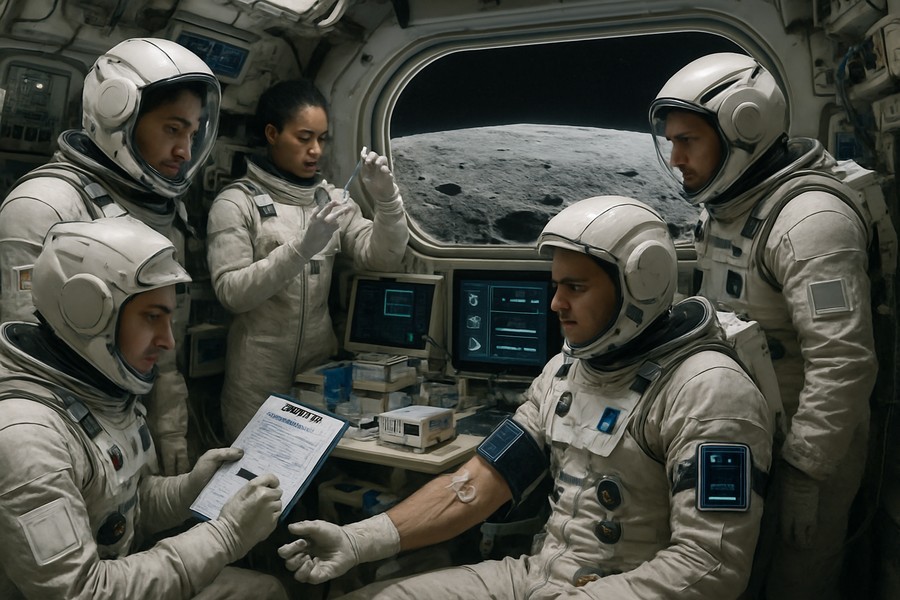
The team of astronauts embarking on the second phase of a moon mission will not only serve as explorers but also as the subjects of scientific study. Their sleep, stress levels, and exposure to radiation will be examined to better understand the impact of deep space on human health.
The Journey to the Moon: A New Understanding of Space Travel
The mission will mark the first crewed flight test of a new spacecraft and rocket system. The four-person team is set to conduct a series of science experiments in addition to navigating the spacecraft in the moon's vicinity.
Interestingly, the astronauts themselves will be transformed into biomedical subjects. The goal is to gather in-flight data about the human body in deep space, an area of study that hasn't been explored for over half a century. This information will add to existing research on the effects of microgravity on the human body.
Health Monitoring in Space
One of the experiments will involve ongoing data collection on how spaceflight influences human health. Biological samples, including blood, urine, and saliva, will be collected before, during, and after the mission. Regular health checks will also be conducted throughout the 10-day journey.
The aim of this research is to track changes in cardiovascular health, nutrition, immunity, and stress at different stages of training, flight, and recovery.
Tracking Sleep and Stress in Space
Another intriguing part of the mission is a project focused on how the astronauts' performance might be affected by the long duration spent away from Earth in a confined space. Each astronaut will wear wrist sensors to monitor their movement and sleep patterns during the mission. Comparisons will be made between the pre-, in-, and post-mission data to gain insights into how deep space missions affect alertness, stress, and team cohesion.
Understanding the Impact on the Immune System
Furthermore, biological samples will be used to study changes in the astronauts' immune systems. Saliva samples will provide markers that will help researchers understand how the body reacts to space radiation. To save space and power, the astronauts will store their saliva on special absorbent papers which, upon the crew's return, will be tested for dormant viruses reactivated by the microgravity environment.
Studying the Effects of Space on Human Tissues
The astronauts will also carry miniature samples of their own blood, grown to simulate bone marrow on microchip devices. These "avatars" will be exposed to the charged particles found in the space between the Earth and the moon. The goal is to study how bone marrow reacts to deep space radiation and microgravity. The results will be compared with previous tests to determine if this technique can accurately predict tissue reactions outside Earth's protective magnetic field.
Radiation Exposure Monitoring
The spacecraft will be equipped with a few active radiation sensors, and the astronauts will each wear personal dosimeters. These devices will measure the constant exposure to radiation throughout the mission and detect sudden increases due to events like solar storms. If radiation levels become dangerously high, the astronauts can create a makeshift radiation shield using the spacecraft's heat shield and water storage canisters, which are better at absorbing radiation than other onboard materials.
