
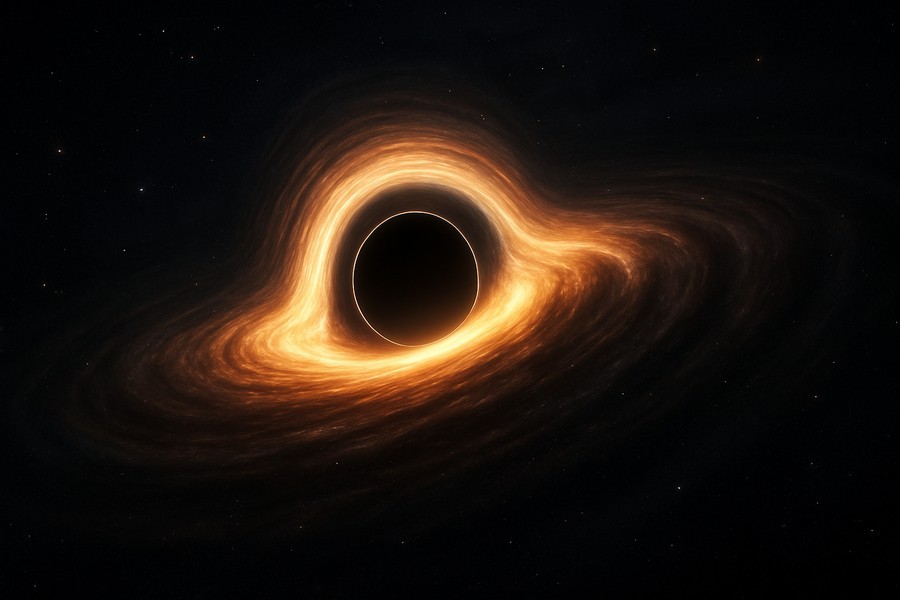
Ancient Black Holes' Rapid Growth Might Solve a Cosmic Puzzle
Researchers may have unlocked the answer to a baffling astronomical question that emerged with the study of the early universe. This question was sparked by the observation of gigantic black holes appearing to have formed less than a billion years after the universe's creation, a phenomenon that contradicts our present understanding of cosmic evolution. However, a recent study suggests these ancient cosmic beasts might have developed so quickly due to a black hole "feasting period."
The research team suggests that the disorderly conditions of the early universe prompted the growth of smaller black holes into the supermassive black holes we see later. This would have happened through a process of mass consumption of all surrounding material. The study utilized cutting-edge computer simulations, revealing that the initial generation of black holes - those created a few hundred million years after the universe's inception - grew rapidly into masses thousands of times larger than our sun.
Overcoming the Eddington Limit
The team's computer models suggest that the first galaxies' turbulent and dense gas-rich environments could have enabled black holes to briefly surpass a threshold known as the "Eddington limit." This limit establishes how much material a celestial body like a star or black hole can consume before the radiation produced by that absorption pushes further matter away, thus depleting its source of gas and dust.
Instances of hyper-consumption that break this limit are called "super-Eddington accretion." These periods serve as the bridge between black holes created by massive star supernova explosions and the colossal supermassive black holes we see today.
Unraveling the Mystery of Supermassive Black Holes
Presently, supermassive black holes with masses millions or billions of times that of the sun exist at the center of all large galaxies. These are not difficult to explain as they've had billions of years to evolve. The puzzle lies in the detection of supermassive black holes as early as 500 million years post-Big Bang. This is because the processes of merging and feeding, which are believed to allow black holes to gain supermassive status, are thought to require at least 1 billion years.
One of the researchers likened the situation to seeing a family with two tall teenagers and a toddler of the same height. Just as it would be puzzling to understand how the toddler grew so tall so quickly, it's equally perplexing to understand how supermassive black holes amassed so much mass in such a short period.
Feasting Frenzy: The Key to Rapid Growth
The researchers' simulations indicate that a super-Eddington feasting period could have allowed the first generation of black holes to feed on the dense early universe gas, reaching masses thousands of times that of our sun. While this doesn't fully explain the formation of supermassive black holes, it provides a significant head start for the merging process that would see increasingly larger black holes collide and combine into an even larger black hole.
Previously, it was thought that only "heavy seeds," or black holes with as much as 100,000 times the mass of the sun, could facilitate the rapid growth of supermassive black holes. This research suggests that "light seeds," or black holes with ten to a few hundred times the mass of the sun, could also grow at extreme rates in the early universe under the right conditions.
The Importance of High-Resolution Simulations
The team's research underscores the importance of high-resolution simulations in studying the early universe. Their findings suggest that the early universe was more chaotic and turbulent than previously expected, with a larger population of massive black holes than anticipated.
As for gathering evidence to support this theory, it might fall to devices designed to detect gravitational waves - the tiny ripples in space caused by events like black hole mergers. One device that could be instrumental in this is the Laser Interferometer Space Antenna, a space-based gravitational wave detector set to launch in the future. This mission could potentially detect the mergers of these rapidly growing, early black holes.