
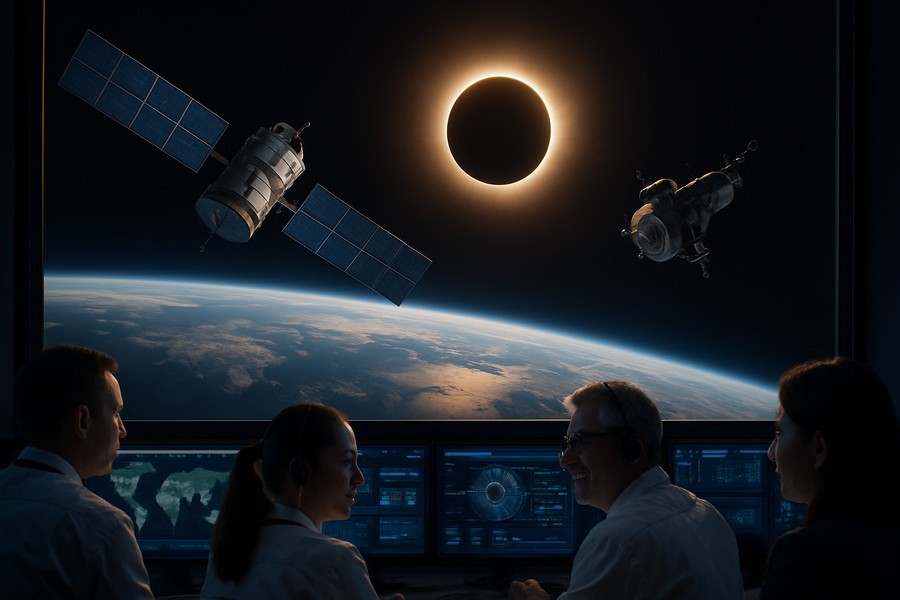
Reconnecting with the Silent Spacecraft: A Tale of Triumph
There is some exciting news for those who keep a keen eye on space exploration. A spacecraft designed to create artificial solar eclipses has reconnected with its controllers on Earth after a whole month of radio silence. This unique satellite is part of a duo working together to study the sun in a way that wasn't possible before. Their mission had been hanging in balance after the spacecraft went offline due to a problem in mid-February.
Following the unexpected silence, the team on the ground erupted in cheer as they received communication from the spacecraft once more. The news brought a wave of relief and excitement amongst the team who had been eagerly waiting for the good news. One of the mission managers expressed his joy, calling it "amazing news" and a "great relief".
A Duo Designed for Solar Exploration
The spacecraft that reestablished contact and its companion satellite were launched together into Earth's orbit. The launch took place from India, towards the end of 2024. The two satellites have been a part of a groundbreaking mission to manufacture solar eclipses in space.
As their mission suggests, one of the satellites, referred to as the Occulter, blocks the sun's disk. This allows the other satellite, the Coronagraph, to study the sun's faint outer atmosphere, also known as the corona. This aspect of the sun is typically overshadowed by the star's overwhelming brightness, but the Coronagraph brings it to light.
The success of this mission hinges on an incredibly precise formation flying. The two satellites travel through space about 500 feet (150 meters) apart. They maintain their positions with an extraordinary accuracy of 1 millimeter. If either the Occulter or the Coronagraph fails, the mission can be considered over. Therefore, the silence from the Coronagraph last month was a significant concern for the team on Earth.
An Unexpected Hiccup
The issue that caused the Coronagraph's silence last month was a chain reaction triggered by an anomaly. The chain reaction resulted in the progressive loss of the spacecraft's orientation, which prevented its entry into safe mode. This was a serious issue for the team, as a loss of orientation can lead to disastrous consequences for the spacecraft and the mission.
A Sign of Hope
However, things are looking up now, as the latest update confirmed. The ground station received a data packet from the Coronagraph, which provided crucial information about the satellite's voltage, temperature, and other characteristics.
Currently, the satellite is stable and in a protective "safe mode". But it's not completely in the clear yet. The team is conducting health checks to determine if the spacecraft suffered any damage.
This is just another example of the ups and downs that come with space exploration. It's a constant reminder of the challenges and the excitement that is a part of this field. Those involved in these missions are hopeful for the satellite's full recovery and look forward to the valuable information it will provide about our life-sustaining star.