
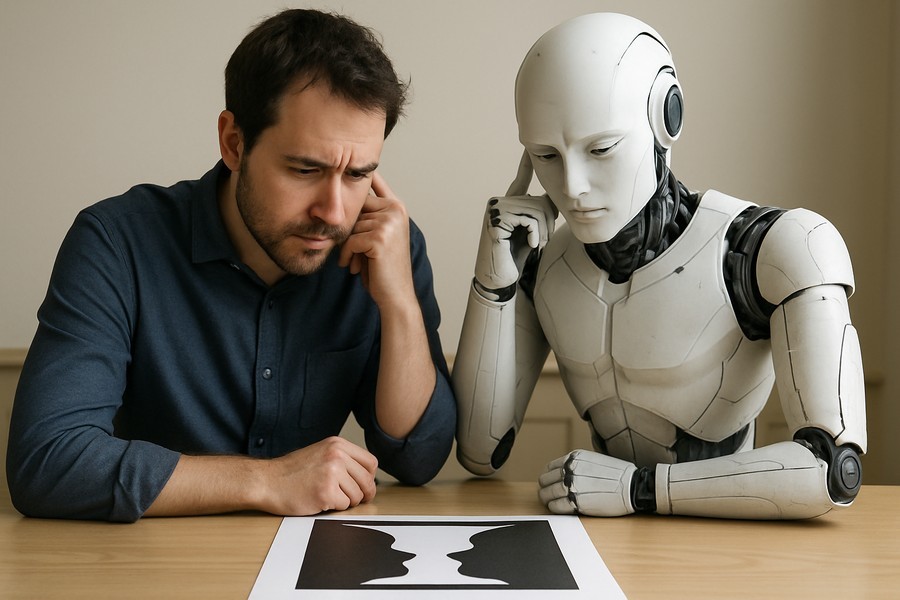
Unraveling the Mystery of Optical Illusions Through AI
Ever wonder why we perceive the Moon to be larger when it's closer to the horizon, even though its size and distance from Earth remain consistent throughout the night? This is just one example of the many optical illusions that fool our eyes. Interestingly, recent findings suggest that not only humans but also artificial intelligence (AI) systems can be tricked by these visual deceptions, which is offering new insights into our brain function.
The Human Brain's Clever Shortcuts
Optical illusions demonstrate that our perception of reality doesn't always match what's truly there. These illusions are often viewed as errors in our visual system. However, they also highlight the ingenious ways in which our brains sift through the most relevant details of our surroundings. The brain only takes in a fraction of the world around us, otherwise, processing every detail of our complex visual environment would be too overwhelming.
AI Systems and Optical Illusions
But what happens when an AI system, specifically a machine vision system, encounters an optical illusion? These systems are designed to spot patterns and anomalies that we might miss. They've been particularly useful in identifying early signs of diseases in medical scans. Deep neural networks, the technology that powers many advanced AI algorithms, have been found to fall for some of the same visual tricks as humans do, leading to fascinating insights into our own brain function.
A study of people who don't experience optical illusions has offered some clues. A man who lost his sight as a child and regained it in his 40s was found not to be fooled by illusions involving shapes. However, he could perceive illusions of motion. This suggests that our ability to perceive motion is more resilient to sensory deprivation compared to understanding shapes. This could be due to us learning to process motion earlier in life or because our shape processing is more adaptable and geared towards recognizing shapes we're frequently exposed to.
Brain-imaging studies have also shed light on which parts of the brain are active when we experience different illusions and how they interact. Perception of optical illusions, however, is subjective and can vary from person to person, making them challenging to study objectively.
AI's Contribution to Understanding Optical Illusions
AI is now offering a fresh perspective on understanding what happens in our brains when we experience optical illusions. Most AI algorithms today, including several chatbots, are powered by deep neural networks, which are models comprising artificial neurons that attempt to mimic how our brain processes information.
These researchers wanted to determine whether a deep neural network could duplicate our brain's responses to illusions involving motion. The AI was trained using videos of natural landscapes, similar to what humans would see while looking around. After processing around a million frames, the AI learned certain rules of the visual world and showed a similar response to humans when presented with a few variations of the rotating snakes illusion.
However, there were differences in how the AI and humans perceive the illusion. For instance, when we focus on one of the rotating circles, it appears to stop spinning while the other circles continue to spin. The AI, however, perceives all the circles moving simultaneously. This could be due to the AI's lack of an attention mechanism, meaning it cannot focus on a specific part of the image but processes it as a whole.
Despite the ability of AI systems and robots to mimic certain aspects of our visual system, no AI system currently exists that can experience all the illusions that humans do.
The Future of AI and Optical Illusions
Some researchers are experimenting with combining AI and quantum mechanics to better simulate human perception of certain illusions. Theories from quantum mechanics have been used to explain our perception of the Necker cube, a well-known ambiguous figure illusion. Classical theories of physics would predict that the cube should be perceived in one way or another. But in quantum mechanics, the cube could be in two states at once until our brain chooses to perceive one.
This approach could also be used to simulate how our visual perception may change in space under different gravitational conditions. For instance, astronauts who have spent time in space have experienced changes in how they perceive optical illusions. Some scientists speculate that this may occur because some aspects of how we judge depth are reliant on gravity.
Though it's a niche area of research, it's crucial for future space exploration. After all, those traveling to the cosmos would certainly want to trust their eyes amidst all the wonders the Universe holds.