
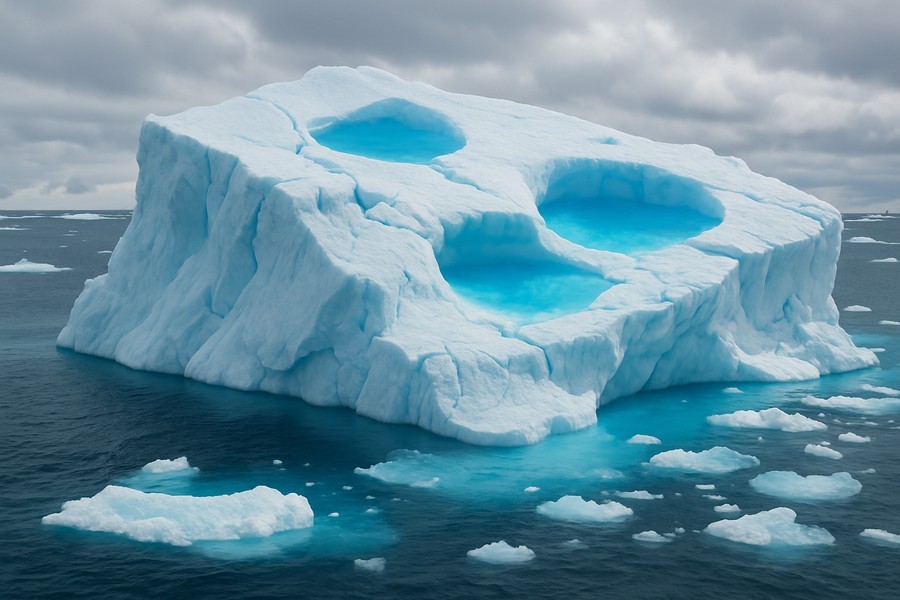
Antarctica's Massive and Ancient Iceberg Changes Color, Signaling Its End
New satellite imagery reveals alarming transformations in the appearance of what was once the world's biggest iceberg. The alarming change is the formation of large pools of blue water, indicating that the iceberg is melting at an alarming rate.
These images provide a glimpse of the remains of a historic iceberg, known as A-23A, located in Antarctica. The current state of the iceberg suggests a possible leak, indicating that its total disintegration may be just a few days away.
The Journey of the Iceberg
The iceberg, currently in the South Atlantic between South America's eastern tip and South Georgia Island, is disintegrating while adrift. The journey of the A-23A iceberg has been long and challenging. It originally separated from Antarctica's Filchner Ice Shelf in 1986. For decades, it stayed stuck on the southern Weddell Sea's seafloor before it broke free in the early 2020s and began drifting towards the north.
In March 2024, the iceberg was trapped in a rotating ocean vortex in the Drake Passage. It then spun out and got stuck again on the shallow coastal shelf south of South Georgia Island. The iceberg managed to free itself again before reaching its final resting place north of the island.
When it first separated, the iceberg was approximately the size of Rhode Island, measuring around 1,500 square miles (4,000 square kilometers). Now, the iceberg is around 456 square miles (1,182 square kilometers) in size, still larger than New York City.
Tracking the Iceberg's Fate
For years, scientists have been monitoring the iceberg's journey using satellite imagery. This has allowed them to document its gradual disintegration over time. Now, it's estimated that the iceberg's lifespan is limited to just a few days or weeks before it completely disappears.
A retired scientist from the University of Maryland Baltimore County, Chris Shuman, shared his predictions about A-23A. He doesn't expect A-23A to survive through the austral summer. Like other Antarctic icebergs, A-23A's journey has been notably long and eventful, but its end is near.
Observations from Space
Scientists have been observing the remains of the waterlogged iceberg using a Moderate Resolution Imaging Spectroradiometer (MODIS) onboard a satellite. The images captured show melting pools on the iceberg's surface that have turned it a haunting blue color.
An astronaut aboard the International Space Station (ISS) also snapped a closer shot of the iceberg. This image showcased blue and white streaks that probably formed when the ice was part of a glacier moving across Antarctic bedrock. According to Walt Meier, a senior research scientist at the National Snow & Ice Data Center, these streaks formed parallel to the direction of flow, resulting in subtle ridges and valleys on the iceberg's surface that now guide the flow of meltwater.
The MODIS image also suggests that the iceberg may have sprung a leak. The accumulated water on the top of the iceberg could have exerted enough pressure at the edges to cause a breakthrough, leading to a white area on the image's left side.
Currently, A-23A is on thin ice, floating in water that's around 37 degrees Fahrenheit (3 degrees Celsius) and heading toward even warmer temperatures. Its time is limited, and it won't be with us much longer.
