
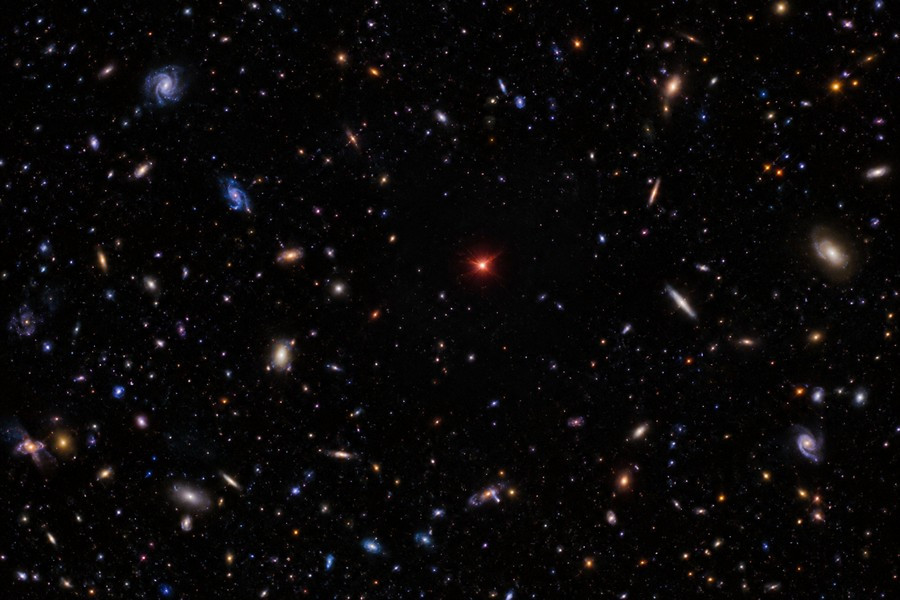
A Bright Signal Appeared Twice in a Patch of Sky That Looked Empty
A small area of sky in the constellation Fornax has been studied in great detail. One space telescope spent more than 270 hours observing it, building an image that contains nearly 10,000 galaxies stretching billions of light-years across the universe.
A newer, more sensitive space telescope later examined the same region using infrared light. In one small part of the image, it found an unusual bright signal. The signal appeared in two sets of observations taken 88 days apart. Yet earlier images of that spot showed nothing at all.
The signal might come from an object too faint to see most of the time that briefly gave off a strong flare. But astronomers do not yet have enough evidence to explain what happened.
Searching Without Picking a Target
Astronomers often study space by splitting light into its separate wavelengths. This method, called spectroscopy, can reveal patterns that are hard to see in an ordinary image. Some atoms absorb particular wavelengths, leaving dark lines in a spectrum. Other atoms and molecules release light at specific wavelengths, creating bright lines called emission lines.
These patterns can help researchers learn about an object's chemical makeup and other features. Usually, astronomers first choose objects already seen in images. They then guide light from those objects into a spectrograph for closer study.
A research team tried a different approach. Instead of starting with known objects, they used a near-infrared spectrograph to search a broad area for signs of objects that earlier observations might have missed.
The team opened almost all of the instrument's tiny shutters, leaving closed only the ones covering known foreground objects. Light from those nearby objects could have interfered with the measurements. The researchers then examined the collected spectra for emission lines. Their method was called Multiobject Coronagraphy for Slitless Spectroscopy.
They repeated the observations from two different viewing angles. Changing the angle helped the team check whether a signal might be caused by an instrument error or other glitch.
Six Matches, Then One Mystery
The well-studied sky region gave the team a way to check its search results against galaxies already identified in earlier images. Six signals that met the team's strict standards matched distant galaxies in the region.
A seventh signal did not fit. It appeared as one bright emission line at a wavelength of about 1.6 micrometers. A line in infrared light is not unusual by itself. The puzzle is that no other line appeared with it, and previous images showed no visible object at that location.
The signal also appeared consistently in all four combined sets of exposures, taken from both viewing angles and separated by 88 days. That makes a simple instrument glitch less likely.
Its brightness adds to the puzzle. The signal was strong enough that it should have appeared in earlier images from the newer telescope. If it had been there during an earlier survey, the telescope should have detected it. One possibility is that the signal was not present at that time.
Several Explanations, None Confirmed
A single emission line is hard to identify. As the universe expands, light traveling through space stretches toward longer, redder wavelengths. So a line seen in infrared light could have started as more energetic light far away, or as less energetic light much closer. Its wavelength alone does not reveal its distance or its source.
The researchers considered four main possibilities:
- An early galaxy: Light from such a galaxy would have had to pass through neutral hydrogen in the young universe. The signal also should have appeared in the earlier telescope survey.
- A more recent galaxy: This explanation faces the same problem with the earlier images. It would also be expected to produce other emission lines, which were not found.
- A supernova: An exploding star could produce a bright signal, but the expected additional emission line is missing.
- A black hole tearing apart a star: This event could create a strong emission line without much other detectable light. However, the available evidence is not enough to show that this is what happened.