
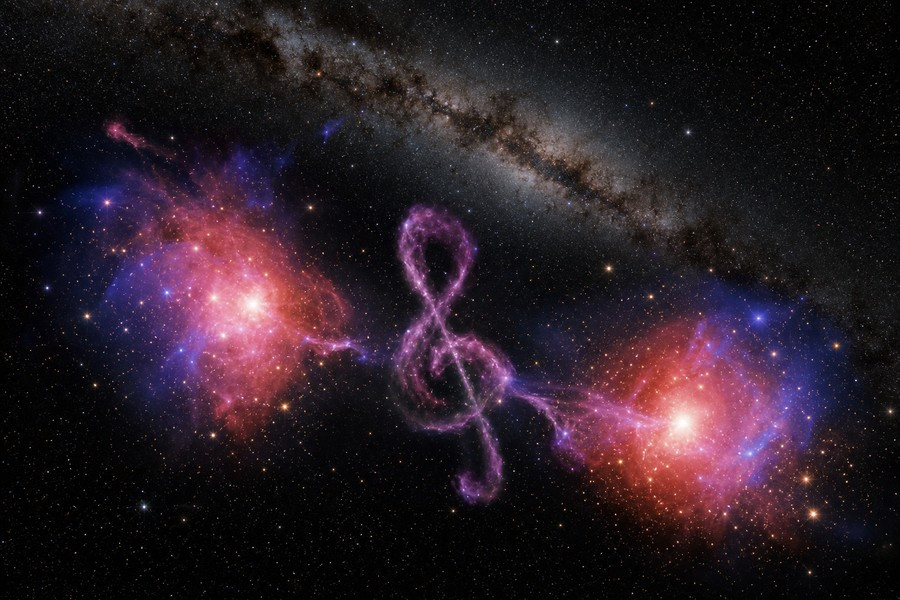
How a Strange Space Formation Took Shape
A large cloud of radio waves in deep space has taken the shape of a musical treble clef. Astronomers believe this unusual structure formed through two powerful events: an eruption from a supermassive black hole and the collision of two galaxy clusters.
A Shape Hidden Behind the Milky Way
The formation is located almost directly behind the flat disk of the Milky Way. Stars, gas, and dust in our own galaxy block much of the view from Earth, making the object difficult to study.
Researchers used several kinds of space telescopes to look through the material between Earth and the distant formation. X-ray observations revealed extremely hot gas around the radio structure. This gas showed that the object sits inside a galaxy cluster.
Further study revealed that the cluster is actually made of two galaxy clusters moving through a merger. Galaxy clusters are among the largest structures in the universe. Each one can contain hundreds of galaxies, along with enormous clouds of gas heated to millions of degrees.
What the Image Shows
A combined image of the region brings together information from X-ray, radio, and infrared observations. The X-ray data appears blue and purple, showing the superheated gas spread across the merging clusters. Radio observations appear red and reveal the curved structure that resembles a treble clef. Infrared data adds light from galaxies, stars, and other objects in the area.
The center of the image contains a broad, oval cloud with uneven edges. Within that cloud is a bright, pinkish radio shape. It has a long central line and sweeping curves that move from top to bottom, creating a loose likeness to the musical symbol.
The resemblance is an example of pareidolia, which happens when people recognize familiar shapes in random patterns. The formation has no scientific connection to music or musical notation.
A Two-Part Cosmic Event
The radio shape most likely developed in two stages.
First, a supermassive black hole near the center of the cluster released a huge burst of energy. The eruption pushed clouds of charged particles and magnetic fields into space at speeds close to the speed of light.
These particles produced strong radio waves. Over time, however, the particles lost energy, and the radio emission became weaker. The structure then entered a quieter phase.
The second stage began when the two galaxy clusters crashed into each other. Their movement created pressure and shock waves through the surrounding gas. These shock waves are similar in some ways to the sonic booms made by aircraft traveling faster than sound.
The collision compressed the old cloud of particles and magnetic fields. It may also have given the particles fresh energy. As a result, the faded radio structure became bright again, allowing it to be detected from Earth.
Clues in the Hot Gas
To examine the collision, researchers studied the shape of the hot gas in the X-ray images. Most of the gas forms a smooth, oval pattern. The team created a second image by removing that regular oval shape from the original data.
The remaining material showed stronger X-ray signals on the left and right sides of the cluster. The center was much fainter. This uneven pattern offers evidence that the two clusters collided along a left-to-right path from the viewpoint of the image.
The collision likely happened several hundred million years ago. The two clusters are now moving away from each other, while the energy from their encounter continues to affect the particles and gas around them.
Why the Discovery Matters
The unusual structure gives scientists a chance to study how black holes and galaxy clusters can shape their surroundings. Black hole eruptions can send energy far beyond the galaxies where they begin. Later events, such as cluster mergers, can revive old clouds of particles and make them visible again through radio waves.
By comparing X-ray, radio, and infrared information, researchers can piece together the history of an object that cannot be understood through one type of light alone. The observations show how an ancient black hole outburst may have been changed by a much later collision between two of the universe’s largest structures.
- A supermassive black hole likely created the original radio-emitting cloud.
- The particles and magnetic fields traveled outward at nearly the speed of light.
- The radio signal weakened as the particles lost energy.
- A collision between two galaxy clusters compressed and reenergized the cloud.
- The resulting radio waves formed a shape that resembles a treble clef.