
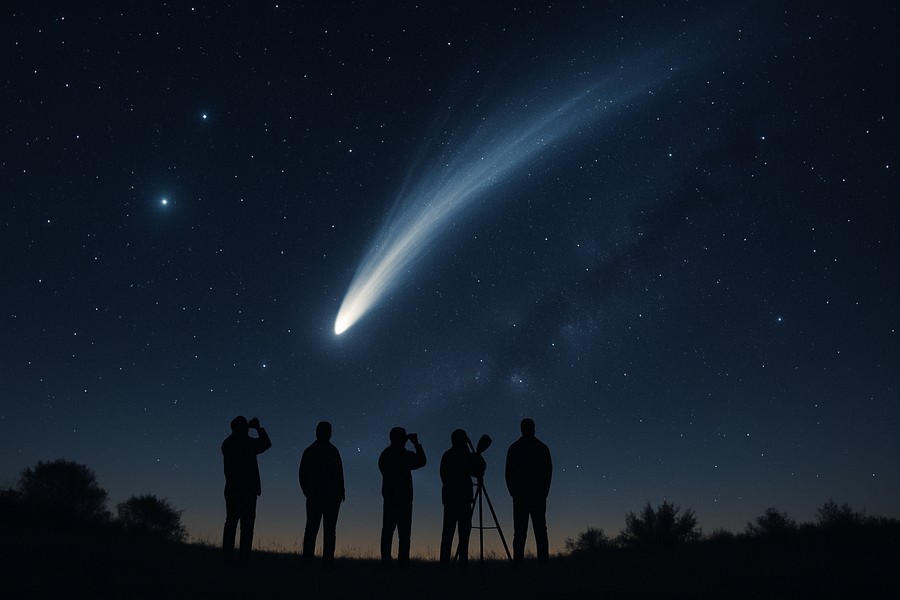
A "Great Comet" Might be Visible Soon
A new comet is making an entrance this year and is projected to be a spectacular sight. This icy celestial object may become visible to us without the need for any telescopic equipment in just a few months. Its closest approach to Earth is expected to happen in less than half a year.
The comet, known as C/2025 R3, was first noticed in pictures taken by two large reflector telescopes situated on a volcano in Hawaii. Currently, it's roughly midway between the orbits of Mars and Jupiter, about 216 million miles away from our planet.
Long-Period Comet
C/2025 R3 is a long-period comet, meaning it completes an orbit around the sun in over a thousand years. Its origin is believed to be the Oort cloud, a massive collection of comets and icy objects near the border of our solar system. The exact path of the comet's orbit hasn't been determined yet, so we don't know how long it takes for it to go around the sun. However, similar comets discovered in recent times have shown us comets that haven't been near Earth for tens of thousands of years.
Close Encounter with the Sun and Earth
Right now, C/2025 R3 is zooming towards the sun and will reach its nearest point to the sun on April 20. At this time, it will be somewhere between the orbits of Venus and Mercury, about 47.4 million miles away from our star. Just a week later, the comet will come closest to Earth, at a distance of 44 million miles, which is far more than the moon's distance from us.
There's still a lot of uncertainty about how bright the comet will be during its journey near the sun. Some predict it will only be visible through a good telescope or binoculars designed for stargazing. Others think it could be bright enough to see with the naked eye. The measurement for this, known as apparent magnitude, works in reverse. This means a lower number equals a brighter object.
When to Look for Comet C/2025 R3
Your best bet to catch a glimpse of C/2025 R3 will be around April 17, before it reaches its closest point to the sun. A new moon on this date will ensure a darker night sky, making it easier to spot objects. However, by the time it comes nearest to Earth, the sun might hide it from view. Those in the Southern Hemisphere might have better luck viewing the comet in early May.
If the comet is directly between Earth and the sun, a phenomenon known as forward scattering could occur. This could result in the comet's tail scattering more sunlight and increasing its brightness. How bright a comet appears also depends on how it reacts to more solar radiation. As a comet gets closer to the sun, it absorbs more sunlight, which causes it to release trapped ice and gases. These reflect sunlight towards Earth. However, it's still too early to predict exactly how this will impact C/2025 R3.
At the time of its closest approach to Earth and the sun, C/2025 R3 will be situated in the constellation Pisces, just below the Great Square of Pegasus.
Could This Be the Next "Great Comet"?
Several remarkable comets have passed by Earth in recent years, including the explosive 12P/Pons-Brooks, the once-in-a-lifetime Tsuchinshan-ATLAS, and the brightly shining comets Lemmon and SWAN. In 2025, the interstellar comet 3I/ATLAS was discovered, which became a sensation due to wild, baseless claims that it was an extraterrestrial spaceship. It reached its closest point to Earth in December and is now moving away quickly, soon to vanish forever.
Currently, there aren't many significant comets predicted to pass by Earth this year. This has led to speculation that C/2025 R3 might be this year's "Great Comet", a term often used to describe the brightest comet of a year. However, there's always a chance that an even more impressive and brighter comet could be discovered and make a similarly spectacular appearance later in the year.