
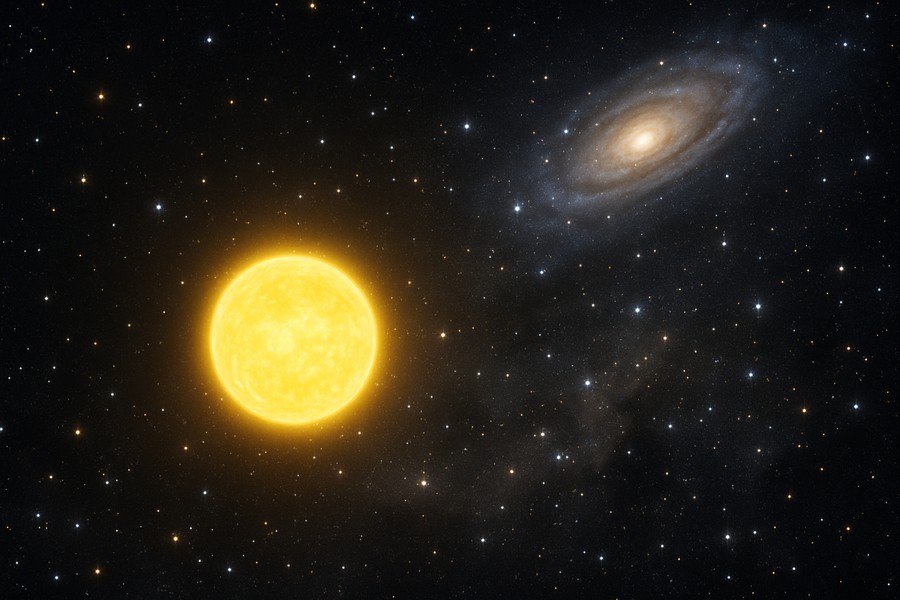
Shocking Transformation in a Cosmic Giant
Imagine a rock star's life: full of brilliance, speed, and early endings. Now, imagine a star that lives the same way. This is the story of one of the universe's largest stars. Like a rock and roll legend, this star is one of a kind and its behavior has been puzzling scientists.
This gigantic star is 28 times the size of our Sun and is nestled in a galaxy neighboring ours, the Large Magellanic Cloud. Over three decades of observation have shown this star acting in ways no other star has before.
Enigma of the Universe's Largest Stars
The life cycle of the universe's largest stars is still a mystery to astronomers, but this particular star is providing them with new data. In 2014, the star underwent a color change, shifting from red to yellow, indicating a rise in its surface temperature. Previously classified as an extreme red supergiant, it swiftly transformed into a yellow hypergiant. This rapid shift, happening over a short time in cosmic terms, did not involve any visible eruption or explosion.
Generally, a star's evolution spans billions of years. In human terms, we only witness sudden and violent events such as eruptions, star mergers, or star deaths. The fast transformation of this star, however, is a phenomenon that current star models cannot completely explain.
A Star Unlike Any Other
When compared to our Sun, this star is incredibly luminous, shining 300,000 times brighter, and its diameter is about 1,500 times bigger. If it replaced our Sun, its surface would stretch to a distance between the orbits of Jupiter and Saturn, the fifth and sixth planets of our solar system. A journey at the speed of light around the star's surface would take six hours.
At an estimated age of 10 million years, this star seems to be approaching the end of its life. In contrast, our Sun, which is about 4.5 billion years old, has an estimated 5 billion more years to go. This star is located roughly 160,000 light-years away from Earth, with one light-year being the distance light travels in a year, approximately 5.9 trillion miles.
Uncertain Fate of Massive Stars
Stars weighing between eight and 23 times the Sun's mass typically evolve into red supergiants and end their lives in a supernova explosion. However, for stars weighing between 23 to 30 times the Sun's mass, their fate is more uncertain. It is yet to be determined whether they explode as a supernova, collapse into a black hole, or transform from a red supergiant to a yellow hypergiant before their end. This star might hold the answer to this question.
Adding to the mystery is that this star appears to be in a gravitational relationship with another star, forming what is known as a binary system. While the size and characteristics of the companion star remain unknown, it is possible that the two stars might merge at some point.
Possible Explanations
Scientists have proposed theories regarding the star's recent changes. One possibility is that it underwent a violent event before observations began, which turned it red, and it is now reverting back to its usual yellow state. Another theory suggests that an interaction between the star and its companion could have temporarily given it the appearance of a red supergiant.
As research continues on this fascinating system, this star is set to revolutionize our understanding of how the universe's most massive stars live and die.