
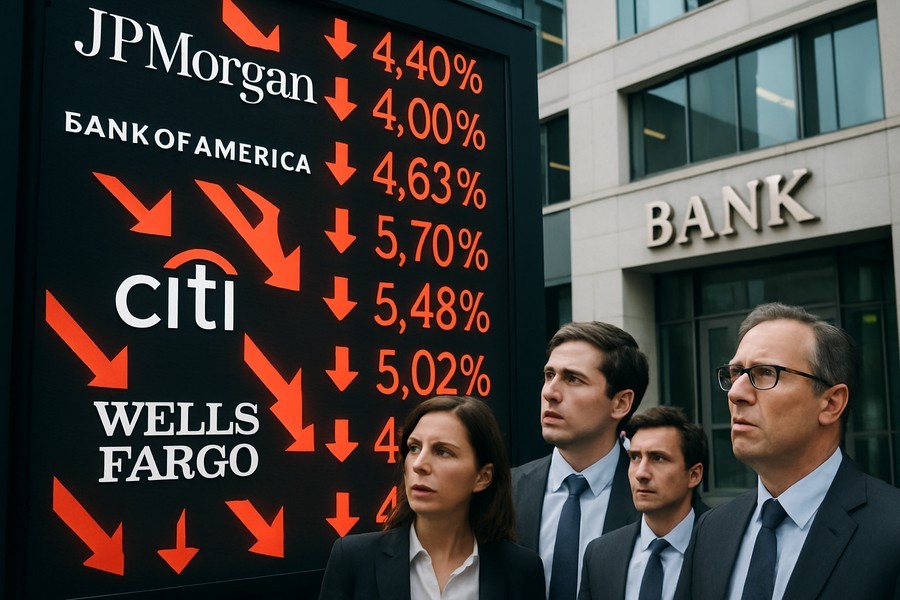
Trump's Call for Lower Credit Card Rates Sends Bank Stocks Tumbling
Bank stocks and financial services took a hit following a statement from US President Donald Trump advocating for a 10% cap on credit card interest rates over the course of a year.
One major bank saw its shares plunge 6% in midday trading, while a prominent financial company experienced a more than 8% tumble. A large portion of their revenue stems from credit cards. More diversified banks witnessed lesser losses. For instance, a leading multinational bank saw its shares drop almost 4%, whereas two American multinational investment banks saw a 2% dip in their stocks.
Furthermore, major credit card payment processors, which don't risk their own capital, also experienced a 2% drop in stock prices.
Other Financial Firms Affected
Other players in the financial services sector were not immune to the effects of the proposed cap. A multinational financial services corporation's shares fell 4%, while a major American multinational financial services company saw its shares decline by about 2%.
The cap, as proposed, would be effective from January 20. Despite the announcement, Trump did not provide specific details about how this plan would be put into action.
Trump's Statement on the Issue
"As the President of the United States, I am calling for a one-year cap on Credit Card Interest Rates of 10% starting from January 20, 2026," Trump stated. This mirrors the promise he made during the 2024 presidential election campaign.
He further added, "We will not allow the American Public to be 'ripped off' by Credit Card Companies anymore."
However, the implementation of such a cap will require the approval of Congress. The idea to curb fees have been a topic of interest for a long time, and previous bipartisan bills proposing a cap on credit card interest rates at 10% indicate a potential willingness for such a move.
Reactions and Implications
When questioned about his announcement, Trump warned banks that refusing to limit rates would put them "in violation of the law."
Over the weekend, critics voiced concerns that Trump's plan, if enacted, could lead banks to reduce lending. This could result in many consumers losing access to credit and a decrease in personal spending, which constitutes approximately two-thirds of all economic activity.
Industry insiders from the banking sector suggest that the White House's proposal could have unintended consequences for consumers and the US economy. They argue that this move could render large portions of the credit card industry unprofitable, particularly for customers with less-than-perfect credit profiles.
Instead of offering unprofitable products, the industry might stop providing access to customers with subprime credit and make changes to card programs, including reducing rewards.
According to these insiders, consumers could end up spending less or relying on other forms of unsecured debt.
Impact on the 'Buy Now, Pay Later' Market
Stocks in the 'buy now, pay later' market initially rose in early trading as more consumers were expected to turn to these lenders if banks were to reduce credit extension. However, these gains were short-lived and reversed once the market officially opened.
A leading financial lending company saw its shares slide more than 6% after a premarket rally, while a popular online payments system company witnessed a 1% fall in its stock prices.