
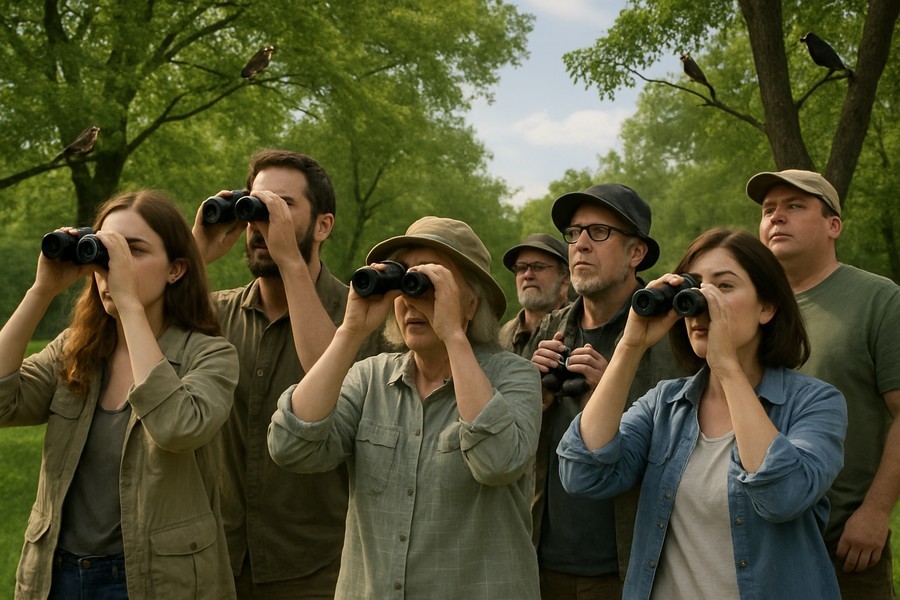
The Hidden Perks of Birdwatching: Cognitive Boosts and Brain Health
It turns out being an avid birdwatcher may do more than just fill your leisure time. Recent research suggests that this pastime could potentially contribute to the way your brain functions and even enhance cognitive abilities as you grow older.
Birdwatchers vs. Beginners: A Comparative Study
A study conducted in Canada compared the brains of 58 adults, some being professional birdwatchers and others being beginners in the field. The results showed that the brains of the birdwatching experts were denser in the areas connected to perception and attention. Increased tissue density could signify better communication between neurons, which in turn could lead to more accurate bird identification.
The main researcher involved in the study, Erik Wing, explained that when you acquire a new skill, your brain undergoes a reorganization process, known as neuroplasticity. This phenomenon has been studied in individuals who have developed specialized skills, including athletes and musicians. Birdwatchers were chosen for this study as their activities involve a unique combination of cognitive areas.
Birdwatching requires a mix of fine-grain identification, visual search, attention to immediate surroundings, sensitivity to motion, pattern detection, and building complex conceptual networks of different related species. Birdwatchers also need to remember what they are seeing and compare it to stored images in their brains.
How MRIs Revealed the Differences
The study divided the participants into two groups. The expert group consisted of 29 people between the ages of 24 and 75, who had been recruited from various birdwatching organizations. The novice group also had 29 participants, ranging in age from 22 to 79, who were recruited from the same birdwatching groups and other outdoor clubs.
During a bird-matching exercise, the experts were more successful than the beginners at identifying bird species, both native and foreign to the area. The researchers used two types of MRI scans to examine the participants' brains: diffusion and functional.
The diffusion MRI, which measures brain structure, revealed that the experts' brains were denser in areas related to working memory, spatial awareness, and object recognition. The functional MRI allowed the researchers to see which parts of the brain were active during the bird-matching exercise. In the experts, the same areas that showed structural differences were engaged during the task, especially when they were identifying foreign birds.
Brain Health Benefits for Older Birdwatchers
Interestingly, the brain differences between expert birdwatchers and beginners were present regardless of age. While the study doesn't confirm that birdwatching can prevent cognitive decline, the results do suggest that birdwatching may support brain health in older adults.
One of the challenges in the study is understanding whether birdwatching directly results in the observed brain differences, or if people with these neurological features are naturally better at birdwatching. Furthermore, since the study participants were recruited from outdoor groups, they might already lead healthier and more active lifestyles.
The Power of Nature and Physical Activity
Other aspects of birdwatching may also contribute to brain health. For instance, birdwatching usually involves being in nature, which is associated with improved attention; walking, which is linked to lower risk of cognitive impairment; and socializing, which is tied to increased processing speed.
Future research could track beginner birdwatchers over time to see if their brains change as they gain expertise. The researchers believe their approach could be used to investigate potential brain reorganization in other complex skills.
"Our interests and experiences, especially those we dedicate extensive periods to, leave a mark on brain structure," Wing said. "We can figure out how people can use these accumulated areas of knowledge that they've built up to support cognition across the entire lifespan."