
Canadian Leader Refutes Rumors of Potential Free Trade Agreement with China Amid US Tariff Threats
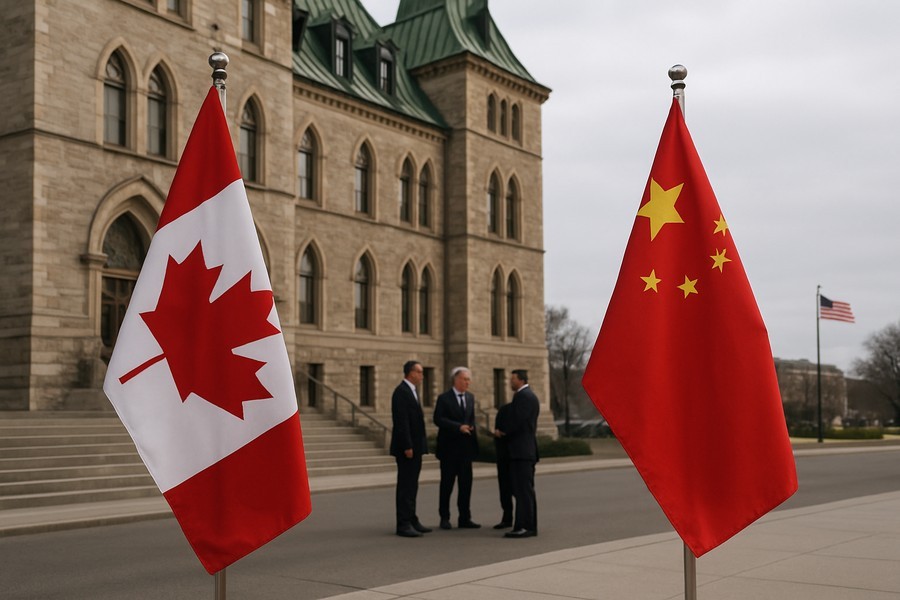
The leader of Canada, Mark Carney, has emphatically stated that his country has no plans to initiate a free trade agreement with China. This clarification comes in the wake of threats from the U.S. President, Donald Trump, to impose heavy tariffs on Canadian goods.
During a recent press conference, Carney reassured that Canada remains committed to its obligations under the trade agreement shared with the U.S. and Mexico. He also assured that no new trade deals would be made without notifying these partners.
Trump's Warning to Canada
Trump's threats of imposing a 100% tariff on Canadian exports were triggered by the possibility of Canada forming a trade partnership with Beijing. In a statement on Truth Social, Trump warned Carney against turning Canada into a gateway for Chinese goods to enter the U.S. market.
This recent spat adds to the mounting tension between the U.S. and Canada. Trump recently rescinded his invitation to Canada to join his "Board of Peace," in response to Carney's speech at the World Economic Forum in Davos. In his address, Carney cautioned against the economic bullying by world superpowers, though he did not mention any country by name.
Conflicting Statements
Interestingly, Trump's aggressive stance on Truth Social contradicts his previous statements on a potential Canada-China agreement. Earlier this month, he expressed support for such a deal, stating that it would be beneficial for Carney. Trump's Treasury Secretary, Scott Bessent, also echoed these sentiments, warning against allowing Canada to become a conduit for inexpensive Chinese goods into the U.S.
Existing Preliminary Agreement with China
Despite these controversies, Canada and China have been able to establish a "preliminary agreement" which led to reduced tariffs on selected goods. This agreement, which came into effect on January 16, allows up to 49,000 Chinese electric vehicles into the Canadian market each year at a lowered tariff rate of 6.1%. This is a significant reduction from the previously increased tariffs of 100% in October 2024.
In return for this concession, China has agreed to cut duties on Canadian agricultural exports, including canola seed oil. The tariffs on this commodity will drop to 15% from March 1, a significant decrease from the current 85%. Other Canadian exports, including canola meal, lobsters, crabs, and peas, will also be exempt from Chinese anti-discrimination tariffs until at least the end of 2026.
Carney's Response
Carney defended the deal with China, stating it was an effort to resolve some issues that had arisen in recent years. He further emphasized that this agreement was in full compliance with the existing trade agreement with the U.S. and Mexico.
It's worth noting that in August 2025, Trump increased tariffs on Canadian goods to 35% from 25%. Under the existing trade agreement, most Canadian exports are not subject to U.S. tariffs. However, certain goods, including steel, copper, and specific autos and auto parts, are still subject to U.S. tariffs.