
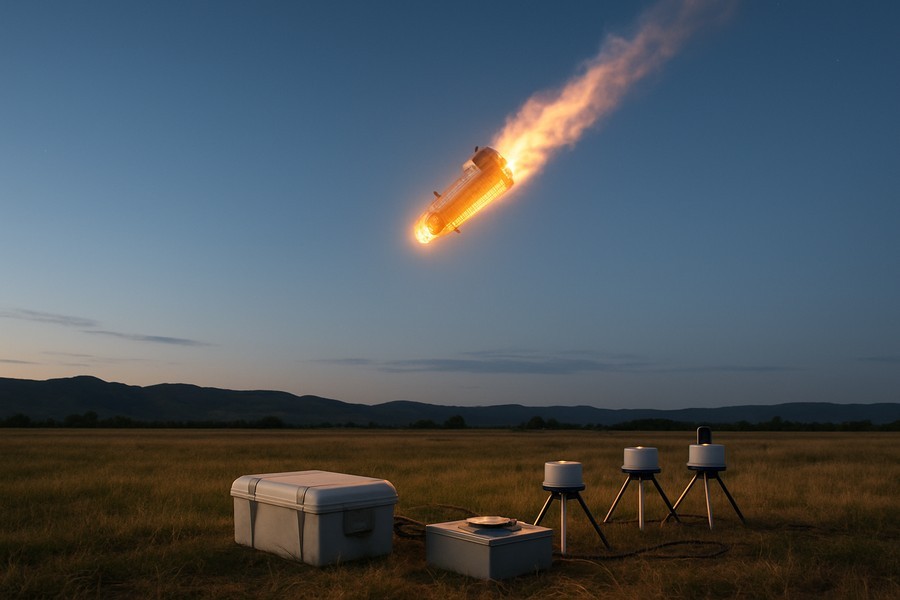
Tracking Space Debris Crash-Landing on Earth with Earthquake Sensors
Every day, around three large chunks of space debris, including defunct satellites and used rocket stages, plummet back to Earth. Surprisingly, our understanding of where these potentially hazardous pieces end up, and how they behave in the atmosphere, is limited. However, a novel technique involving earthquake sensors tracking sonic booms could help us trace these hurtling fragments in real time.
A Recent Space Debris Incident
In a recent incident, a massive piece of a Chinese rocket was projected to crash-land in southern Europe, leading to the temporary shutdown of certain airspace sections in Spain and France. This event affected hundreds of flights and resulted in considerable financial damage. Eventually, the rocket part reentered Earth's atmosphere across the world, over the Pacific Ocean.
This occurrence highlighted a glaring issue: our current space traffic monitors know very little about the behavior of objects reentering from orbit. Fortunately, a new technique proposed by researchers may help us better manage this problem in the future.
The Current Method of Tracking Space Debris
At present, the path of reentering space debris is predicted using measurements from a worldwide network of radars and optical telescopes. While this method is effective when the object is still in orbit, it has its limitations. Once the object descends below a couple of hundred kilometers in altitude, its interactions with the atmosphere become less predictable, making it challenging to determine where it will re-enter.
Moreover, ground-based radars, which are not evenly distributed around the globe, struggle to monitor the disintegration of the returning space object. Furthermore, the data collected is not instantly accessible to everyone who might need it.
Seismic Sensors vs Ground-based Radars
Interestingly, large parts of the globe are densely covered with seismic sensors designed to detect earthquakes. These sensors not only pick up tremors from Earth's interior but also explosions, traffic vibrations, and even the sounds made by whales in the ocean. Most importantly, the data collected from these sensors is mostly openly available online.
Using Seismic Sensors to Track Space Debris
In a recent study, researchers used data from seismic sensors to reconstruct the path of an orbital module that detached from a crew capsule and fell to Earth. While the 1.5-ton piece of debris was predicted to crash-land in the South Pacific or the North Atlantic, the predictions turned out to be entirely incorrect.
The team analyzed data from 127 earthquake sensors across California, tracking the propagation of the sonic boom created by the module as it raced through Earth's atmosphere at speeds up to 30 times the speed of sound. They discovered that the module traveled roughly 25 miles north of the trajectory predicted by U.S. Space Command, with fragments potentially landing somewhere between Bakersfield, California, and Las Vegas, Nevada.
The Importance of Tracking Space Debris
The importance of accurately tracking space debris cannot be overstated. While the data cannot predict where a piece of space debris will crash-land, it can help accurately locate the impact sites, enabling ground teams to retrieve any possibly toxic fragments that could be harmful to the environment.
For instance, in 1978, a reentering Russian satellite broke apart over Canada, scattering radioactive debris from its onboard nuclear reactor. Most of this toxic debris was never found.
The Future of Space Debris Tracking
The new tracking technique could also help answer the big question of how much space debris actually reaches the surface of Earth. Some companies assert that their satellites completely disintegrate during reentry, but many experts dispute this claim, arguing that some components made of sturdy materials likely survive. Better understanding of how completely satellites burn up in the atmosphere will help experts assess the risk these objects pose to people and property on Earth, as well as to aircraft in flight.
In future studies, the team aims to analyze data from other types of sensors and potentially track space debris across even larger areas. These other sensors, which are based on acoustic measurements, can detect sonic booms at distances of several hundred miles, extending the method's reach even further.