
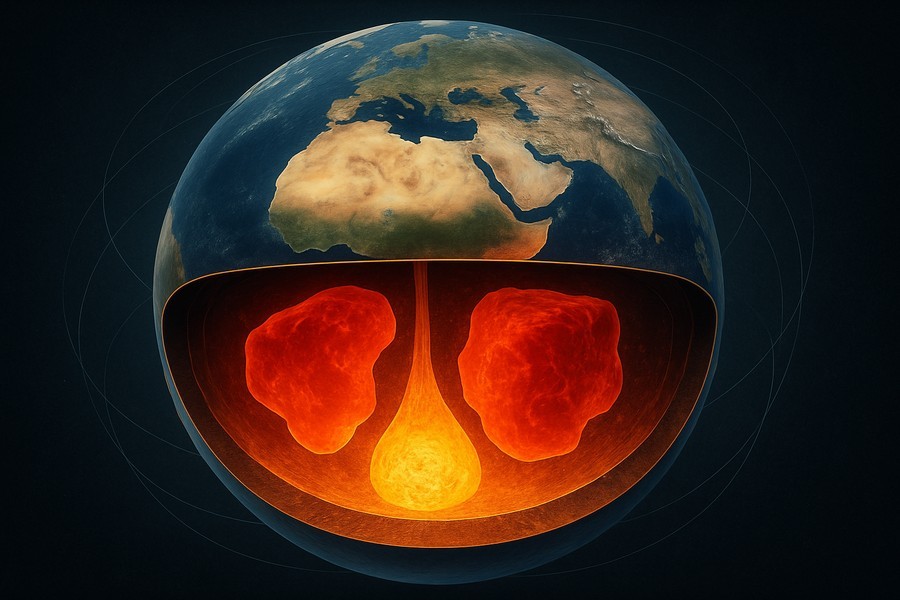
Two Giant, Hot Structures Deep in the Earth Impact Our Planet's Magnetic Field
Despite our extensive knowledge of the cosmos, it seems we know very little about what's deep inside our own planet. Fascinatingly, the Earth's magnetic field, which has guided countless explorers and serves as a protective shield against harmful solar radiation, might be greatly influenced by two massive, heated rock structures deep within the Earth.
The discovery of these two enormous structures, more commonly referred to as 'blobs', was recently announced by a group of researchers. These solid, superheated blobs, located approximately 1,864 miles (3,000 kilometers) beneath Africa and the Pacific Ocean, have likely been shaping the Earth's magnetic field for millions of years.
What are these Blobs?
These blobs, as large as continents, are significantly hotter than the surrounding lower mantle. This creates a stark temperature contrast in the rocky mantle. The lead researcher, a geologist from the University Kingdom, explains that this contrast helps maintain the flow of Earth's fluid outer core, also known as the geodynamo.
Without this massive internal heat transfer from core to mantle and eventually to the surface, our planet would be magnetically dead, much like Mars and Venus. The geodynamo, powered by electric currents generated by the movement of extremely hot iron and nickel, is crucial to the existence of Earth's magnetic field.
Understanding Earth's Magnetism
In order to study the historical patterns in Earth's magnetism, scientists examine the magnetic records contained in rocks and other natural materials. For example, igneous rocks that form from cooled magma acquire a permanent magnetism that reflects the direction of Earth's magnetic field at the time and place of cooling.
While analyzing such rocks, the researchers noticed distinct patterns in the magnetic records of rocks up to 250 million years old. These patterns showed a strong connection with the longitude and latitude of where the rocks presumably formed.
Investigating the Role of Blobs in Earth's Magnetic Field
Scientists have increasingly been studying these blobs over recent years, due to their suspected connection with volcanic eruptions. However, the research team also wanted to explore whether these blobs could offer insight into the role of volcanic eruptions in Earth's magnetic field.
To further their understanding, the researchers developed advanced simulations to map Earth's magnetic field, taking into account different heat profiles for the core, mantle, and blob. After several trials, the most accurate map represented the model that incorporated strong variations in heat transfers, which would be the case if the blobs were actively mingling between the outer core and lower mantle.
Furthermore, the researchers found that the presence of these blobs contributed to the overall stability of the magnetic field, with certain sections of the field remaining unchanged for hundreds of millions of years.
Current Understanding and Future Research
Despite these intriguing findings, these blobs remain a mystery to scientists. Their exact origin and nature are still unclear. However, if the simulations are correct, it seems these blobs play a significant role in maintaining the stability of our planet. Therefore, we owe much to these mysterious structures deep within our Earth.
