
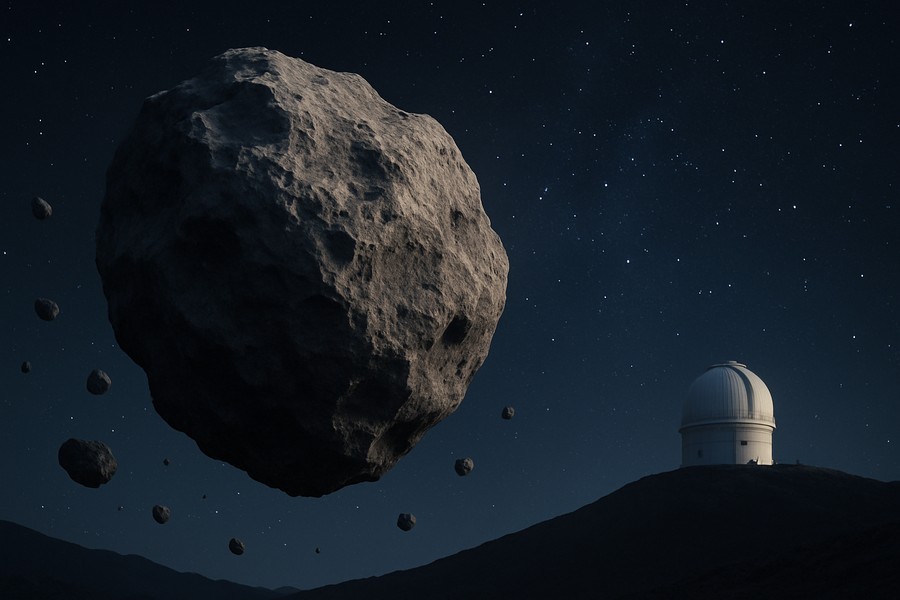
Unprecedented Discovery of a Gigantic, Speedy Asteroid
An enormous asteroid, larger than most skyscrapers on Earth, has been discovered spinning at an unprecedented speed. The asteroid, named 2025 MN45, boasts a width of approximately 2,300 feet (710 meters) and completes a rotation every 113 seconds. This makes it the fastest spinning asteroid known to us that is over 1,640 feet (500 meters) in diameter.
Understanding the Mysteries of the Universe
The discovery is part of a larger project aimed at learning more about the formation and evolution of small celestial bodies like asteroids. The research used the largest digital camera in the world, which will continuously monitor the night sky in the Southern Hemisphere for ten years. This will create an unparalleled time-lapse movie of the universe, offering valuable insights into the cosmos.
A Closer Look at Asteroids
Asteroids are essentially large rocks floating in space. They are often remnants from the early stages of our solar system, which is around 4.5 billion years old. By studying these celestial bodies, scientists can learn about the changes that our solar system has undergone throughout its existence.
The discovery of 2025 MN45 was made possible by preliminary data from the observatory. In just seven nights of observations, the observatory has uncovered thousands of previously unknown asteroids orbiting around our solar system. The project is set to officially start in the coming months and is expected to reveal even more about the universe.
An Exciting Find
The incredibly fast-spinning asteroid has sparked excitement amongst the research team, as it provides hints about the composition of the ancient rock. The asteroid's fast rotation suggests that it must be made of very strong materials to prevent it from breaking apart.
Most asteroids are believed to be 'rubble pile' asteroids, which means they are composed of numerous small pieces of rock and debris that have come together under the influence of gravity during the formation of the solar system or as a result of subsequent collisions. The fact that 2025 MN45 is not a 'rubble pile' but a single solid rock is indeed surprising.
More Discoveries on the Horizon
Fast-spinning asteroids like 2025 MN45 may have reached their current state due to a collision with another asteroid. It is also possible that 2025 MN45 is the remainder of a much larger asteroid that got broken into pieces by a cosmic collision.
Most of the asteroids in our solar system can be found in the main asteroid belt between Mars and Jupiter. However, most of the fast-spinning asteroids we have observed are much closer to Earth, simply because they are easier to observe. 2025 MN45, on the other hand, is located in the main asteroid belt.
2025 MN45 is not the only fast spinner in the main asteroid belt. There are also 16 "super-fast" rotators and two "ultra-fast" rotators. All these asteroids are longer than 100 yards (90 m), and all but one of them reside in the main belt.
A closer examination of the data from the observatory has revealed about 1,900 never-before-seen asteroids. With the official start of the ten-year survey on the horizon, we can expect many more exciting discoveries in the near future.
