
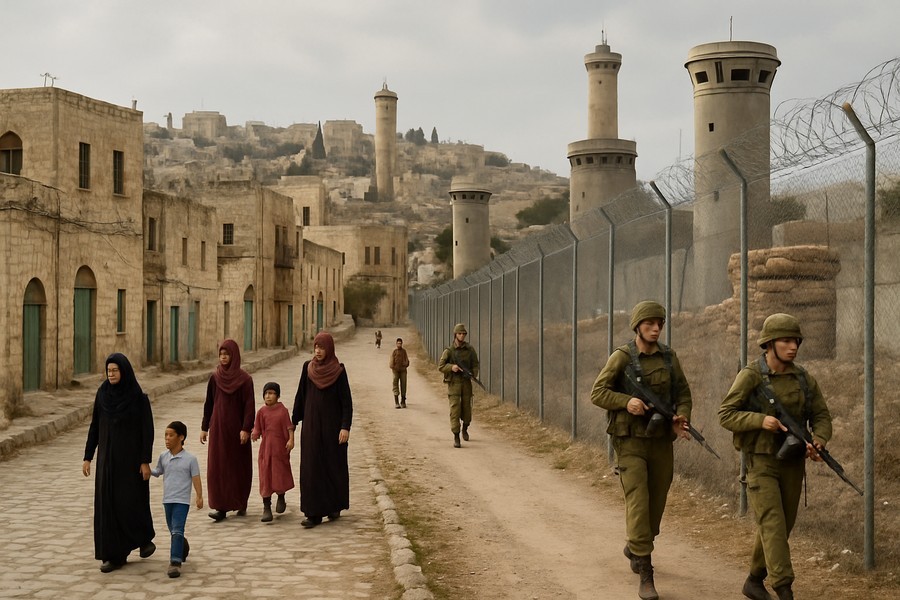
Hebron's Mayor Speaks Out Amidst Growing Israeli Influence in the West Bank
The acting mayor of Hebron, Asma al-Sharabati, expressed deep concern over Israel's increasing control in the West Bank. She believes that recent legal changes, which were passed by Israeli cabinet ministers, will result in the Palestinian authorities being left out of decisions related to urban development and planning.
Hebron, a city known for its recurring conflicts, has Israeli soldiers maintaining security for hundreds of Israeli settlers living among Palestinians within an Israeli military base.
Significant Changes to Power Distribution
Recent shifts in power distribution in the West Bank were approved by Israel's security cabinet. These changes, which are a departure from the division of powers agreed upon three decades ago, include expanding Israel's control into providing municipal services in Palestinian-run regions. Additionally, Israel now has broad powers to take control of "heritage sites" throughout the West Bank for environmental and archaeological protection.
Israel's control will also extend to urban development planning at the Cave of the Patriarchs in Hebron, an important religious site. Al-Sharabati expressed her apprehension over these changes, stating that now any building could be declared ancient and Palestinian authorities won't be part of any decision-making process.
Increased Tensions in Hebron
Hebron's typically vibrant vegetable market is located just a few meters away from a tense, deserted area marked by closed Palestinian shops and streets blocked for the protection of Israeli settlers. This volatile region, known as H2, is home to Issa Amro, a Palestinian activist.
Amro lives amidst this divide, his home adorned with a plaque reading "Free Palestine". Through his window, he can see a large Israeli flag waving over the streets below. He points out nearby Palestinian buildings that are now vacant due to growing tensions and Israel's expanding control. He argues that the recent changes are different, as they are now legally backed.
New Changes and their Implications
Israel intends to start offering municipal services to Jewish settlers in Hebron and to allow private Israeli citizens to own land across the West Bank. Palestinians are prohibited from selling property to non-Palestinians under Jordanian and Palestinian law.
Palestinians who have secretly sold to Israelis in the past could now face significant risks due to Israel's planned publication of the classified land registry. The social stigma associated with selling to the Israeli occupier is deeply ingrained among Palestinians.
International Law and the Future of Palestinian Statehood
Over 700,000 Israeli settlers live in the West Bank and Israeli-annexed East Jerusalem, territories seized by Israel from Jordan during the 1967 Middle East War. The Palestinian people desire these lands for their prospective independent state along with the Gaza Strip. It's important to note that these settlements are deemed illegal under international law.
The recent transfer of civilian powers in Palestinian-run areas marks a significant shift in Israel's control over the West Bank. The Israeli Finance Minister stated that they are "deepening their roots in all parts of the land of Israel" and "burying the idea of a Palestinian state".
However, these legal changes not only dismantle agreements signed decades ago, but they also weaken the remaining powers of the Palestinian Authority. Hebron's mayor, al-Sharabati, stated, "We are living the ugly truth that we are not protected."
The United States' Role in the Situation
The Palestinian President has called for a "firm response" from the US, arguing that Israel's decision disrupts their efforts in the region and violates international law. However, the US has done little beyond expressing opposition to Israel's formal annexation of the West Bank.
Several countries, including the UK, have recognized a Palestinian State. With Israel now having civilian powers in Palestinian-controlled territory, it remains to be seen how these countries will respond. The UK government has promised to share more information in the coming days.
The implementation of the US peace plan for Gaza relies heavily on the support of Arab countries, most of whom are advocating for progress towards a Palestinian state. The escalating situation in Hebron and the West Bank could potentially jeopardize the vision for peace in the Middle East.