
Transforming Leftovers from Whiskey Production into High-Performance Energy Storers
The lucrative whiskey industry, specifically the production of bourbon, generates a considerable amount of grain waste. However, innovators at a prominent university in Kentucky have discovered a method to repurpose this waste, turning it into high-functioning energy storage devices known as supercapacitors. This groundbreaking work was showcased at a recent gathering of esteemed chemists in Atlanta, Georgia.
The Story of Bourbon
Bourbon, a type of aged whiskey deeply rooted in American history, saw a significant growth in demand following World War II. To legally qualify as bourbon, the spirit must contain a mash made up of at least 51% corn, with the balance comprising other grains, typically rye and barley.
The bourbon production process involves grinding the grain, mixing it with water, and adding a sour mash from a previous distillation. Yeast is then introduced to the mixture to initiate fermentation. The fermented mash is then distilled to produce a clear spirit known as "white dog". This spirit is aged for a minimum of two years in new oak barrels charred on the inside. The charring process caramelizes sugars and releases vanillin into the bourbon, giving it its distinctive dark color and flavor. Once used, these barrels are not reused for bourbon production but are typically repurposed for making barrel-aged beer, wine, and even barbecue and hot sauces.
The Problem of Waste
However, the bourbon-making process is not entirely efficient. A significant amount of used mash, known as stillage, is wasted. A graduate chemistry student at the University of Kentucky, Josiel Barrios Cossio was astonished to discover that for every barrel of final bourbon product, the waste stillage equivalent of six to ten barrels is produced. This waste is often sold to farmers as animal feed or soil additives, but drying it out is costly and transporting it in its wet state is challenging.
Converting Waste into Energy Storers
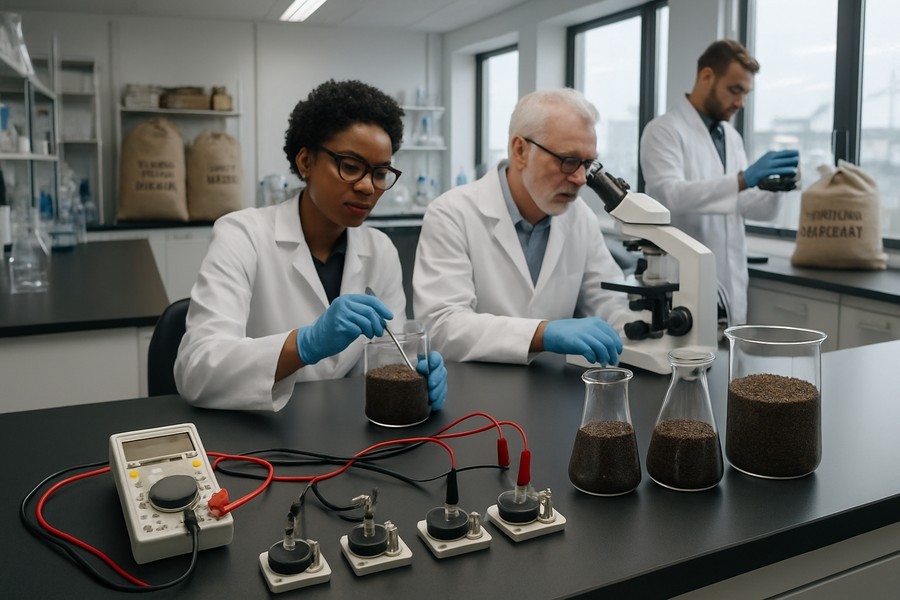
Barrios Cossio and his mentor, Marcelo Guzman, speculated that this waste stillage could be transformed into valuable carbon materials using a high-pressure cooking method known as hydrothermal carbonization. Leveraging their connections with local distillery owners, they obtained samples of waste stillage for their experiments.
The duo introduced the stillage to a reactor, where heat and pressure converted it into a black powder. The powder was then baked at 392° F (200° C) to turn it into hard carbon, similar to graphite. In some instances, potassium hydroxide was added and the temperature increased to 1,472° F (800° C) to produce activated carbon. Both forms of carbon hold distinct advantages for energy storage.
Creating Supercapacitors from Leftovers
Barrios Cossio and Guzman used the activated carbon to create electrodes for double-layer capacitors, inserting a liquid electrolyte in between the electrodes. In their initial tests, these devices could store up to 48 watts per kilogram. Inspired by these results, they proceeded to create a hybrid device with one activated carbon electrode and one hard carbon electrode, infusing both with lithium ions. The outcome was a hybrid supercapacitor capable of storing up to 25 times the energy per kilogram compared to a standard supercapacitor.
While these results are promising, more research is needed to develop larger supercapacitors and to assess the economic viability and sustainability of this method on a larger scale.