
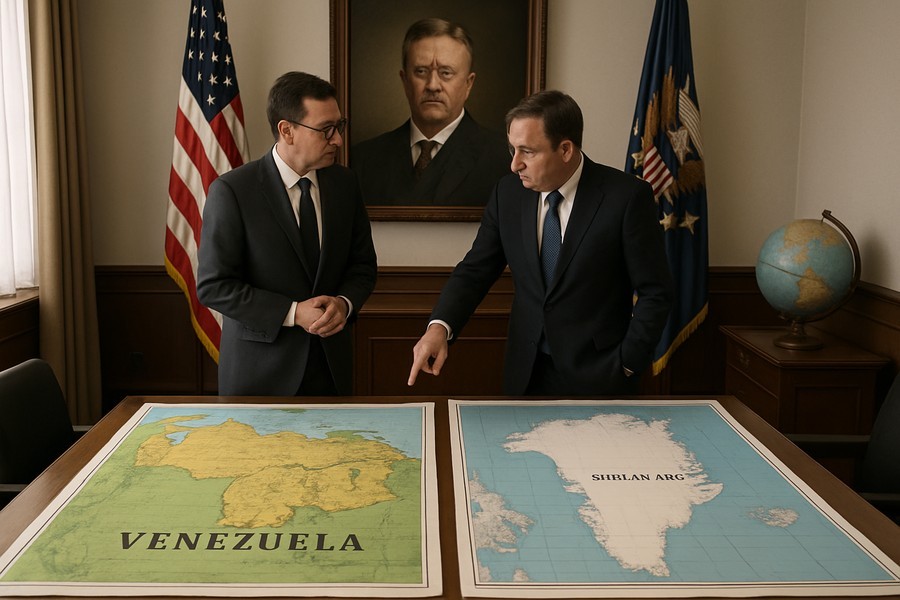
How Trump's Actions Echo Past American Policies
The current U.S. administration appears to be drawing on historical concepts of American foreign policy, such as the Monroe Doctrine and Gunboat diplomacy, to justify its actions in Venezuela, Greenland, and Iran. The president's interpretation of these doctrines seems to guide his aggressive stance towards acquiring Greenland, pressuring Venezuela, and making threats towards Iran.
During a recent press conference, the president declared that his administration had detained the Venezuelan President for violating the fundamental principles of American foreign policy, principles established more than two hundred years ago with the Monroe Doctrine. The president further stated that the Monroe Doctrine has evolved significantly and is now referred to as the "Donroe Doctrine".
Understanding the Monroe Doctrine
The Monroe Doctrine was established in 1823 when President James Monroe warned European nations not to interfere in the Western Hemisphere, stating that such actions would be considered hostile to American peace and safety. This doctrine was formed during a time when Spain was struggling to maintain its North American territories, which included parts of present-day Florida and the Southwest.
The Monroe Doctrine was birthed during a time when the U.S. was emerging as a global power and was asserting its influence in the Western Hemisphere. This doctrine was intentionally vague, allowing future American leaders to adapt and apply it to new contexts.
The doctrine underwent a significant transformation eight decades later under President Theodore Roosevelt, who viewed it as a more robust policy. Roosevelt's stance was in part a reaction to Britain, Germany, and Italy's naval blockade of Venezuelan ports over unresolved foreign debts. He argued that "chronic wrongdoing" on the global stage necessitated intervention by a civilized nation.
Roosevelt's Interpretation of the Monroe Doctrine
Roosevelt believed in diplomacy as the primary means of resolving international disputes, with military action only being used as a last resort. However, he also understood that the U.S. might have to assert its power in cases of severe wrongdoing or incompetence. This belief led to an expansion of the Monroe Doctrine, known as the Roosevelt Corollary, which justified intervention in Latin America to maintain regional stability.
Interestingly, while this administration seems to subscribe to the principles of the Monroe Doctrine, it appears to reverse Roosevelt's priorities, placing military action before diplomacy. This approach was evident in the handling of the Venezuela situation, where diplomacy seemed to be set aside in favor of forceful action.
The Evolution of American Diplomacy
Following the Monroe and Roosevelt doctrines, President Woodrow Wilson introduced a more aggressive, interventionist approach, often referred to as "gunboat diplomacy". Utilizing America's expanding naval power, Wilson sent U.S. Marines to Haiti and the Dominican Republic to protect U.S. financial interests. He also ordered the U.S. Navy to occupy the Mexican port of Veracruz in a bid to depose Mexico's dictator.
Like the current administration, Wilson portrayed himself as a peacemaker, advocating for the creation of an international peace-keeping body, the League of Nations, following World War I. However, his actions contrasted sharply with this image, as he ordered numerous interventions in the Caribbean and Central America.
While the current administration's approach to foreign policy seems to draw from historical doctrines, it's important to remember that each president interprets and applies these doctrines differently. As such, analyzing the administration's actions solely based on past policies may lead to oversimplification.
Ultimately, the current administration's tactics seem to be influenced by a type of realpolitik, informed by a transactional approach to relations with other nations. While some may draw parallels between the current president and past leaders like Theodore Roosevelt, significant differences exist. For instance, the current administration's apparent disregard for international law contrasts sharply with Roosevelt's support for international arbitration.
While U.S. interventions in Latin America have continued beyond World War II, the Monroe Doctrine has been invoked less frequently. This is likely due to the U.S.'s status as a global superpower after World War II, making the doctrine seem less relevant. However, as the global order changes, we may see the return of spheres of influence, as the world grapples with the impact of shifting power dynamics.