
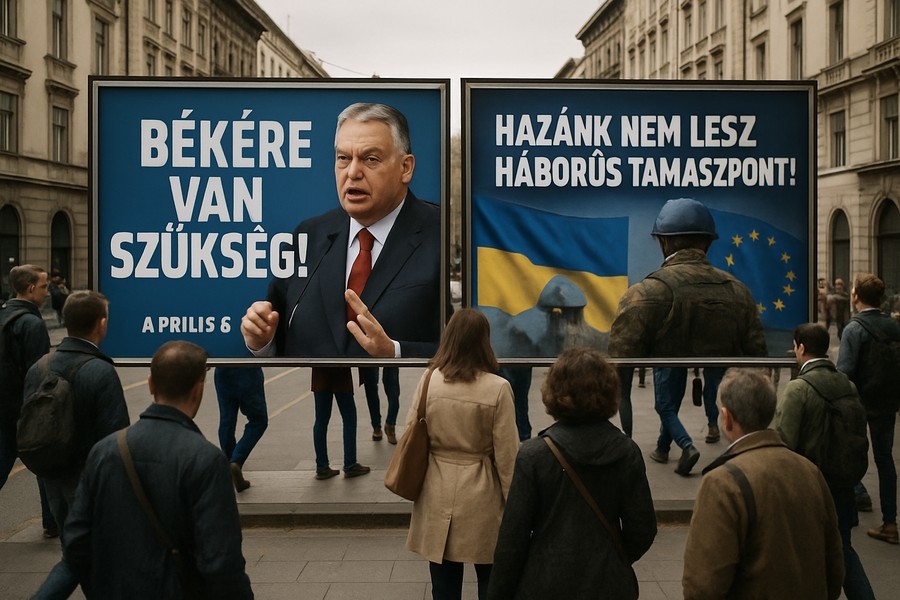
Orbán Bets on Anti-Ukraine Stance for Re-Election
Despite a challenging election ahead, Hungary's pro-Russian leader is trying to persuade his citizens that the largest danger they face isn't economic decline - an issue his main contender is emphasizing - but rather the neighboring Ukraine.
Viktor Orbán is running a vigorous campaign filled with misinformation. His central message is that Hungarians should reject joining the rest of Europe in supporting Ukraine against Russia's assault. He suggests that this approach could lead to financial ruin for the country and put its young people in harm's way.
A Scare Campaign
Billboards have been put up across the country displaying computer-generated images of Ukrainian President Volodymyr Zelenskyy with European officials, seemingly asking for money. This is a clear jab at the European Union's efforts to provide financial support to Ukraine and strengthen its defenses amidst the ongoing war.
The publicly funded billboards boldly declare, "We won't pay!". This makes it evident why the outcome of Hungary's upcoming election has implications beyond its borders. Hungary recently obstructed a new package of EU sanctions on Russia after interruptions in Russian oil supplies passing through Ukraine. They have pledged to veto any further pro-Ukraine policies until oil flows are restored.
Orbán is widely regarded as the Kremlin's strongest ally in the EU. As almost all of the other 26 nations in the bloc have distanced themselves from Russia since the war began, Hungary has increased cooperation.
Orban's Relationship with Russia
The prime minister describes his relationship with Russian President Vladimir Putin as practical, due to Hungary's access to reliable supplies of Russian oil and gas. However, Orbán's policies and actions, such as his anti-LGBTQ+ stance, media crackdowns, and labeling critics as "foreign agents", have led to allegations that he's following Putin's authoritarian rulebook.
Challenging Times Ahead for Orban
Orbán, who rose to power again in 2010, is facing the strongest threat to his power in the upcoming election. His right-wing party is currently behind in most independent polls to a rising center-right challenger. This challenger, a 44-year-old lawyer, has centered his campaign on reducing living costs, boosting social services, and curtailing corruption. He also promises to restore Hungary's western alignment and strengthen democratic institutions which have deteriorated during Orbán's time in power.
The Power of Misinformation
With the increasing popularity of the challenger, Orbán and his party are trying to shift the narrative. They have covered the country with taxpayer-funded billboards and advertisements on radio, television, and social media. One mailer sent to all eligible Hungarian voters claimed that the EU's plans to financially aid Ukraine would lead to economic disaster.
Other ads, funded by a mysterious pro-government organization with ties to Orbán's party, portray the challenger as a puppet of the Ukrainian president and the EU, who would betray the country to foreign interests and draw Hungary into the war.
Many news outlets loyal to Orbán's government echo these claims, stating that Ukraine wishes to extend the bloody conflict that has already claimed the lives of thousands of its citizens and is conspiring with the EU to do so.
Escalating Tensions and Public Response
For years, Orbán has strived to hinder EU efforts to provide financial and military support to Ukraine, and he has staunchly opposed sanctions targeting Russian oil and officials. The situation with Ukraine worsened recently after Russian oil shipments to Hungary were disrupted; Ukraine blamed the disruption on a Russian drone strike that damaged a pipeline. Orbán labeled it as blackmail.
Despite the anti-Ukraine campaign resonating with many Hungarians loyal to Orbán's party, a victory in the polls is far from guaranteed. Many Hungarians remain skeptical of Orbán's anti-Ukraine messaging. Recently, hundreds of Hungarians and Ukrainians, including many refugees, gathered in central Budapest to commemorate the four-year anniversary of Russia's invasion. They held Ukrainian and Hungarian flags, chanting "Stop Putin, stop the war!"
Meanwhile, a young student from the Ukrainian city of Odesa studying in Budapest finds the billboards depicting her country's president amusing. She said, "The main message of these billboards is that Ukraine will steal Hungarian money. But come on, you're using these AI images from the Hungarian budget to do what? To win elections."
