
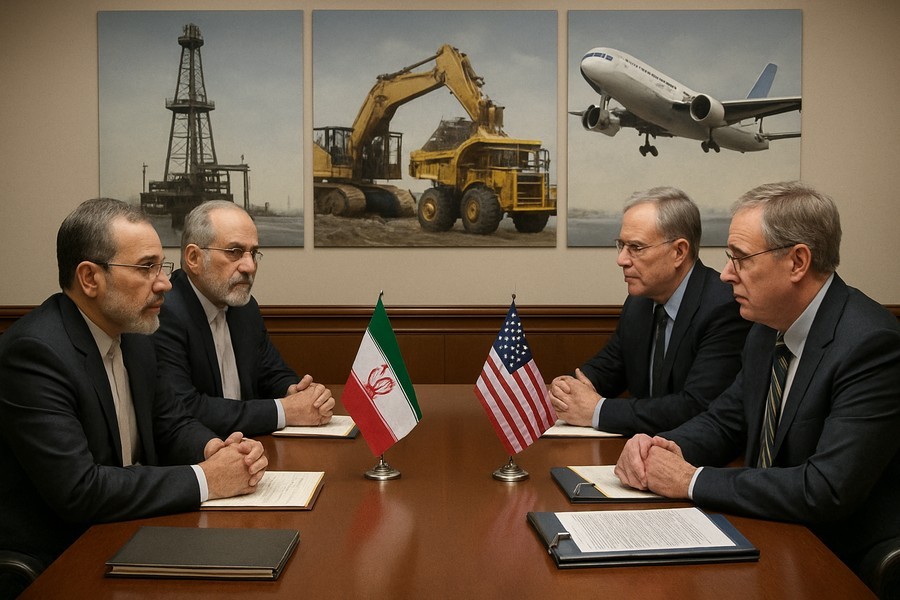
Iran and U.S. Discuss Potential Economic Opportunities Amid Nuclear Talks
Both Iran and the United States stand to gain economically from their ongoing nuclear negotiations, according to an Iranian diplomat. The two countries are currently engaged in another round of discussions aimed at resolving longstanding disagreements over Iran's nuclear ambitions.
These negotiations come at a time when the U.S. has increased its military presence in the region, hinting at the possibility of a prolonged military campaign if the talks fail. Despite the looming threat, the preference for diplomatic resolution and a negotiated settlement has been emphasized by the U.S. government.
Challenges and Hopes in Negotiation
However, the difficulty in striking a successful deal with Iran has been acknowledged. "No one's ever been able to do a successful deal with Iran but we're going to try," a high-ranking U.S. official stated.
Iranian officials have warned that they would retaliate against U.S. bases in the Middle East if attacked. Yet, they have also expressed a willingness to negotiate. "For the sake of an agreement's durability, it is essential that the U.S. also benefits in areas with high and quick economic returns," said a senior figure from Iran's foreign ministry.
Potential Economic Benefits
These potential economic benefits could include mutual interests in oil and gas fields, mining investments, and aircraft purchases. Despite the 2015 nuclear agreement between Iran and world powers, the current talks are being held as it was argued that the previous pact did not secure U.S. economic interests.
In 2018, the U.S. withdrew from the 2015 agreement, which had eased sanctions on Iran in exchange for restrictions on its nuclear programme. Following the withdrawal, the U.S. re-imposed harsh economic sanctions on Iran.
Upcoming meetings between U.S. and Iranian officials are expected to take place soon. The current negotiations are exclusive to the U.S. and Iran, with a neutral third party acting as a mediator.
Iran's Commitment to the Talks
Iran's Foreign Minister has travelled to Geneva to participate in the indirect nuclear talks with the U.S. He is also expected to meet the head of the UN nuclear watchdog and other officials. Deputy Foreign Minister expressed Iran's willingness to negotiate its nuclear program in return for sanctions relief, stating that it's now up to America to show their commitment to a deal.
As a demonstration of Iran's flexibility in negotiation, a senior Iranian official referred to the country's atomic chief's recent statement that Iran may agree to dilute its most highly enriched uranium in return for lifting sanctions. However, Iran maintains that it will not accept zero uranium enrichment, a major sticking point in past negotiations. The U.S. sees enrichment within Iran as a potential route to nuclear weapons, a claim that Iran firmly denies.
Increased Pressure on Iran
Amid these negotiations, the U.S., in collaboration with Israel, has taken military action against Iranian nuclear sites. Furthermore, the U.S. is planning to intensify economic pressure on Iran by aiming to reduce Iran's oil exports to China, which currently makes up more than 80% of Iran's oil exports. Any significant reduction in this trade would greatly impact Iran's oil revenue.
Moreover, the American government has stated that any deal with Iran should involve the dismantling of Iran's nuclear infrastructure, not just halting the enrichment process. The importance of completely eliminating Iran's ability to enrich uranium has been emphasized.
A Shift in Relations
In other news, a long-standing recipient of U.S. military aid, Israel, plans to terminate this aid within the next decade, following the end of the current 10-year deal in 2028. The decision comes as a result of a prospering economy, which allows for a transition from aid to partnership with the U.S.
"We want to move with the United States from aid to partnership," an Israeli official stated. The aim is to phase out the financial component of the military aid and transition to a partnership over a ten-year period.