
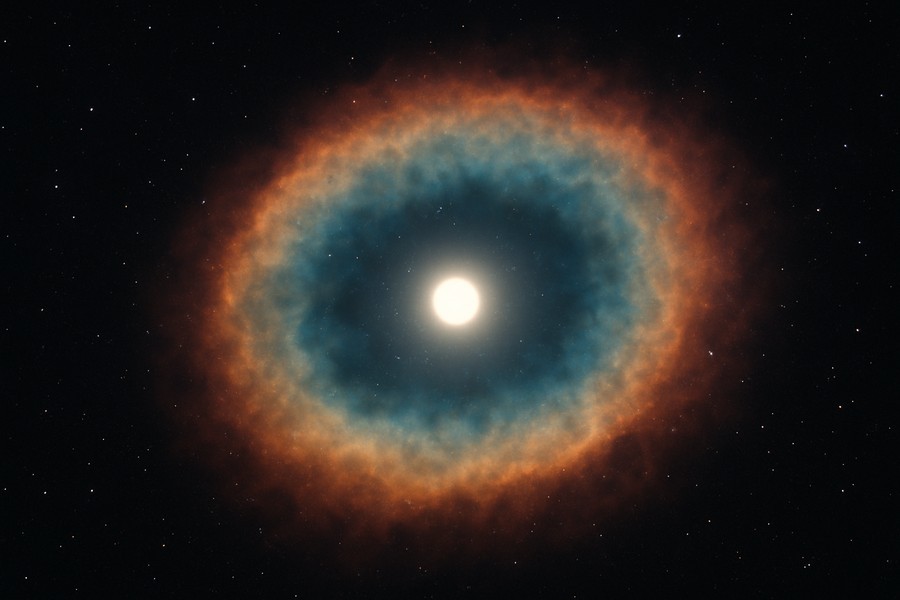
Stunning Image Depicts Star's Gradual Disintegration
A breathtaking snapshot captured by a space telescope paints a vivid picture of a star's last moments as it disintegrates into gas and dust. This awe-inspiring view provides a grim glimpse into the potential future of our very own Sun.
The image, captured by an infrared device onboard the telescope, presents a detailed view of a glowing, expanding ring of hot material. This hot substance was expelled by a star, which, in its later life, shed its outer layers to become what is known as a white dwarf - a compact, dense core. This white dwarf is currently in the process of bombarding the surrounding cloud with ionizing radiation.
Recognizing the Celestial Spectacle
Upon taking a broader look, you might recognize this celestial event as the renowned Helix Nebula, famous for its uncanny resemblance to the "Eye of Sauron" from the "Lord of the Rings" series. Positioned 650 light years away, this remarkable object is identified as a planetary nebula. However, this term is somewhat misleading as these nebulae have no connection with planets but are entirely related to stars. The white dwarf was once a star of moderate size, similar to our Sun. As it approached the end of its life cycle, it expanded and transformed into a red giant, eventually shedding its shell and exposing its depleted core.
The Afterlife of a Star
The material that a star expels during its demise doesn't simply disappear. Just as deceased animals on Earth decompose and enrich the environment with nutrients, a similar phenomenon occurs when stars die, albeit on a much grander scale and over millions of years. The nebula contributes to the universe by spreading heavier elements that were formed within the star and other vital materials necessary for the creation of future planetary star systems around different suns.
A collage of these cosmic interactions, which are akin to a form of celestial recycling, is visible in the telescope image. Here, faint spots of blue signify the hottest gases, while the cooler, yellowish areas house hydrogen and clusters of dust clouds. These dust clouds are sites where complex molecules can take shape.
The Solitary White Dwarf and its Spectacular Companions
The Helix Nebula is home to a lone white dwarf. However, these remnants of stars are often discovered in binary pairs, which create an impressive display in their own right. If a white dwarf's partner orbits too closely, the dense core can begin to siphon material from its companion star. When enough material amasses on the surface of the white dwarf, it triggers a colossal thermonuclear explosion known as a nova. These novas can outshine even a nebula, although their brilliance is short-lived.

