
Unveiling the Mysteries of Space: 'Unsuccessful Stars' Discovered in a Dazzling Cluster
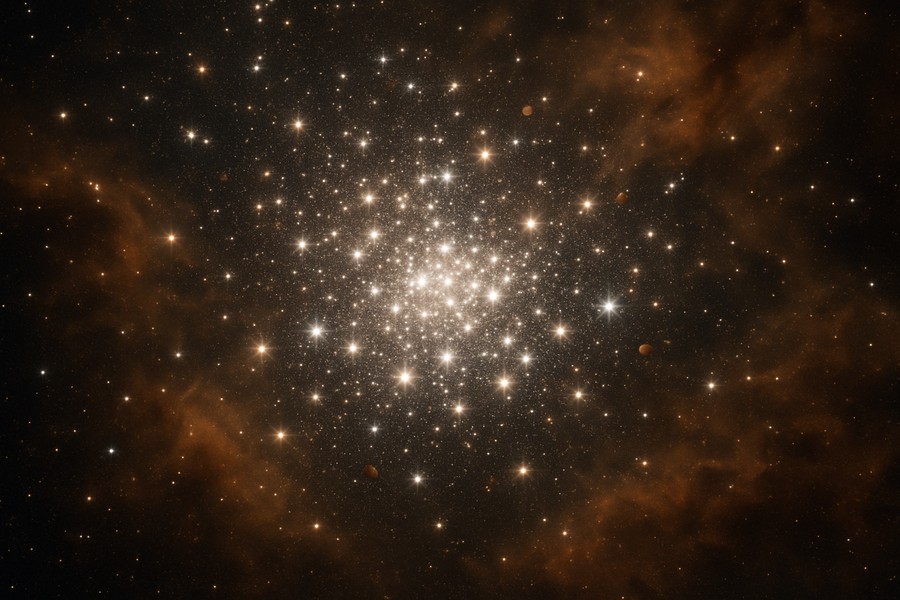
Enveloped by a stunning mixture of orange and brown cosmic clouds, an image brimming with glistening stars has been captured by a space telescope. This breathtaking view doesn't just present a mesmerizing spectacle; it also reveals a doorway into the fascinating universe.
This image showcases the renowned star cluster, Westerlund 2, located within Gum 29, a nebula known for star creation. This stunning celestial tableau is unfolding a staggering 20,000 light-years away from our home planet, nestled within the confines of the Milky Way galaxy.
The Compact and Sparkling Cluster of Westerlund 2
The glittering cluster of Westerlund 2 is small yet densely packed, with its diameter ranging from 6 to 13 light-years. It's home to an estimated 3,000 stars, making it a bustling neighborhood in our galaxy. Despite being only about 2 million years old, the cluster boasts some of the most spectacular stars—hot, bright, and massive.
A decade ago, the same cluster was imaged by a different space telescope in honor of its 25th year in orbit. That image, created using visible light combined with near-infrared data, revealed the complex and intricate features of Westerlund 2 and its surrounding nebula, painting a stunning picture of dust pillars, ridges, and valleys.
A New and Vibrant Perspective
Now, the same space telescope has unveiled an even more vivid view of this cluster swarming with young, luminous stars. This latest image is a result of combining infrared data captured by the telescope's Near-Infrared Camera and Mid-Infrared Instrument.
The breathtaking image doesn't just highlight the youthful, massive stars but also the dust clouds shaped and sculpted by their intense light. These uniquely shaped regions are enclosed by strands of red and orange gas, brilliantly lit by the potent light from the neighboring stars.
Interconnected Cosmic Show
This captivating scene features a web of blue and pink strands that seem to be cosmic material drifting away from the scene. Numerous tiny stars that are just starting to shine can be seen, still nestled within the thick cosmic cloud they were formed in. Larger and brighter stars, located much closer to us, display an eight-pronged pattern caused by the interaction of their light with the telescope's instruments.
This twinkling array of countless stars is a testament to the ongoing cycle of star formation. Infant stars in the stellar nursery emit intense radiation, heating the surrounding nebula and sparking the birth of new stars.
Unraveling the Mystery of 'Failed Stars'
The new observations span a wide range of infrared wavelengths, including bands that are sensitive to methane and polycyclic aromatic hydrocarbon (PAH) emissions. While PAH emissions trace heated gas and dust, methane helps to trace cold, low-mass objects. This led to the identification of a group of brown dwarfs, often referred to as 'failed stars', including some objects only about ten times as massive as Jupiter.
Brown dwarfs are intriguing objects that blur the line between stars and planets. They possess masses that fall between those of typical stars and planets, often ranging from 10 to 90 times the mass of Jupiter. However, they lack the mass needed to initiate nuclear fusion in their cores. The new observations made by the space telescope could provide valuable insights into the various stages of a star's life and the functioning of planet-forming disks around massive stars.