
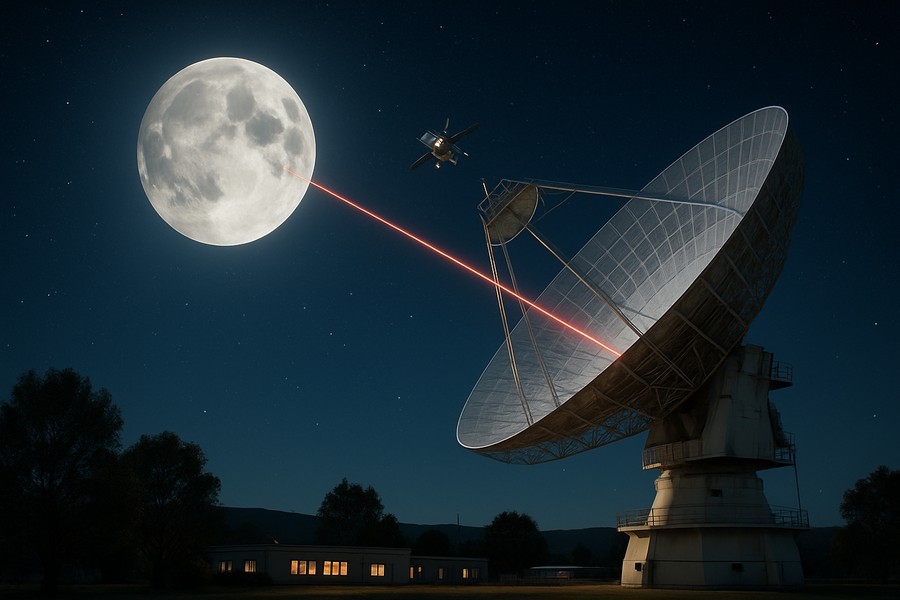
Revolutionizing Space Communication: A Glimpse into a Laser-Focused Future
Communication during space travel, especially long-distance journeys like those to the moon, presents significant hurdles. The farther astronauts are from Earth, the greater the communication challenges become, particularly when dealing with large amounts of data. However, a new laser-based communications system may soon change this landscape.
Communicating with the Moon and Beyond
A future moon mission is set to test a new laser-based communication system, known as O2O. This test could pave the way for more efficient communication with astronauts and smoother transmission of data. O2O also promises to let everyone on Earth be a part of the journey.
A leading professor in the field of electrical and computer engineering believes that O2O may significantly reduce the communication gap between astronauts in space and their counterparts on Earth. The upcoming mission is considered a substantial leap forward in achieving faster communication speeds and meeting the evolving information needs.
The Mechanism behind O2O
Conventionally, communication between spacecraft and Earth involves radio signals, which, despite traveling at the speed of light, have a round-trip delay of about three seconds from Earth to the moon and back. Also, the bandwidth is limited, meaning the more data sent, especially images and videos, the longer it takes.
O2O aims to solve these problems by utilizing infrared light lasers. This technology can transmit voice, mission data, and high-resolution images and videos back to Earth. The upcoming mission will use both traditional radio networks and the new laser communication system during its journey. It's the eighth time this technology has been tested.
During the flight, communication support will alternate between ground stations and relay satellites within various space networks. This will help maintain near-continuous contact with the crew throughout the mission.
The Impact of O2O on Earth
The hope is that O2O will enable more data from space to be sent than ever before. According to researchers, laser communication systems can transmit over 100 times more data than comparable radio networks, even from millions of miles away.
Integrating this technology into spaceflight makes it possible to send live, high-quality footage from deep space. This could mean higher-quality images and videos from the spacecraft, even from hundreds of thousands of miles away.
However, communication blackouts will still occur. For instance, during the upcoming flight, there will be a communications blackout for approximately 41 minutes when the spacecraft carrying the astronauts passes behind the moon. Future lunar missions may use orbiting relay satellites to entirely avoid these blackouts.
Is O2O the Future of Deep-Space Missions?
Despite its promise, O2O won't be used on the next planned mission. However, it could pave the way for future laser communication systems for the Moon and Mars.
Experts believe that laser communications could be crucial for future Mars and moon missions due to the unforgiving communication delays at such deep-space distances. The technology would allow more science data and crew communications, bringing those following the missions from the ground closer to the action than ever before.
While research has already shown that the technology works, seeing it perform during the upcoming mission could provide the proof needed to demonstrate its reliability at deep-space distances. This could help build broader confidence in using laser-based communications for future missions.
Moreover, the benefits of this technology extend beyond space travel. It could improve weather forecasts and even phone capabilities on Earth, as the technology trickles down into remote sensing satellites, weather satellites, and communication satellites.
