
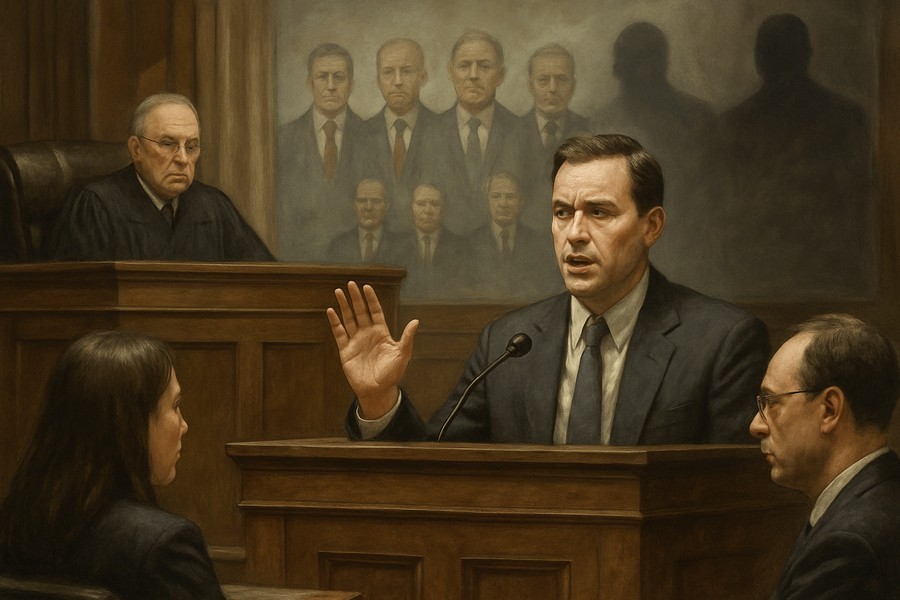
Businessman Accused of Orchestrating Assassination Attempt on Political Figures Cites Iranian Coercion
In a chilling case that seems more suited for a Hollywood thriller, a Pakistani businessman has been accused of hiring assassins to eliminate a U.S. political figure. The individual, identified as Asif Merchant, allegedly confessed to his intentions during his trial for attempted terrorism, and interestingly, he has claimed that he was operated under serious duress from Iran's powerful paramilitary Revolutionary Guard.
Merchant, the defendant, revealed that the intended targets of his 2024 plot included Donald Trump, who was president at the time, Joe Biden, his predecessor, and Nikki Haley, the former presidential candidate and U.S. Ambassador to the U.N. However, he insisted that he was compelled to act due to life-threatening peril his family in Iran was facing. He hoped he would be arrested before he could execute the plot.
Driven by Fear, Not Willingness
"My family was under threat, and I had to do this," Merchant explained in court, speaking through an Urdu interpreter. He did not want to do this willingly, he insisted. Merchant believed he would be arrested before anyone was harmed, and he intended to cooperate with U.S. authorities in the hope of securing a green card.
Indeed, U.S. authorities were already aware of his activities. The assassins he attempted to hire and paid $5,000 were, in fact, undercover FBI agents. Merchant was arrested in July of 2024, just a day before an unrelated attempt on Trump's life.
During a search, investigators found a handwritten note containing codewords for different aspects of the plot. Merchant did voluntarily sit for FBI interviews, though he ended up facing trial instead of a cooperation deal.
Assistant U.S. Attorney Nina Gupta questioned Merchant in court, asking, "You traveled to the United States for the purpose of hiring Mafia members to kill a politician, correct?" To this, Merchant replied affirmatively, maintaining a matter-of-fact demeanor despite the unusual nature of his testimony.
The Context of Iran's Involvement
The trial is proceeding against the backdrop of the recent Iran war, which resulted in the death of Iranian Supreme Leader Ayatollah Ali Khamenei. The Iranian government has categorically denied any involvement in a plot to assassinate Trump or any other U.S. officials.
Merchant, who had a long banking career in Pakistan, later diversified into various businesses including clothing, car sales, and banana exports. He has families in both Pakistan and Iran. He claimed that he was introduced to an intelligence operative from the Revolutionary Guard during one of his visits to Iran. They initially discussed getting involved in an informal money transfer system known as hawala.
Merchant's regular visits to the U.S. for his garment business sparked the interest of his Revolutionary Guard contact, who trained him in countersurveillance techniques. The U.S. classifies the Revolutionary Guard as a "foreign terrorist organization."
Merchant was instructed by his handler to recruit U.S. residents willing to work for Iran. Later, he was assigned a more ominous task: to find a criminal who could arrange protests, carry out thefts, launder money, and even facilitate a murder. Merchant remembered, "He did not tell me exactly who it is, but he told me - he named three people: Donald Trump, Joe Biden, and Nikki Haley."
"No Other Option"
After being questioned and searched by U.S. immigration agents at the Houston airport in April 2024, Merchant believed he was under surveillance. Regardless, he continued to research Trump's rally locations and plan a shooting at a political rally. He even managed to collect $5,000 from a relative to pay his supposed hitmen as a "token of appreciation."
Merchant reported updates to his Revolutionary Guard contact by sending falsified observations tucked into a book, which he shipped to Iran through a series of intermediaries. He claimed he had no choice but to comply as his handler was aware of his Iranian family's whereabouts.
Prosecutors pointed out in a court filing that Merchant never sought law enforcement's assistance before his arrest. In his defense, Merchant argued that he couldn't approach authorities due to constant surveillance by his handler's associates.
During his FBI interviews, Merchant failed to mention any facts that could support the claim that he acted under duress. Merchant told the court that he didn't think agents would believe his story because their questions made him feel like they considered him a "super-spy."
"And are you a super-spy?" his defense lawyer Avraham Moskowitz asked. To this, Merchant firmly replied, "No. Absolutely not."