
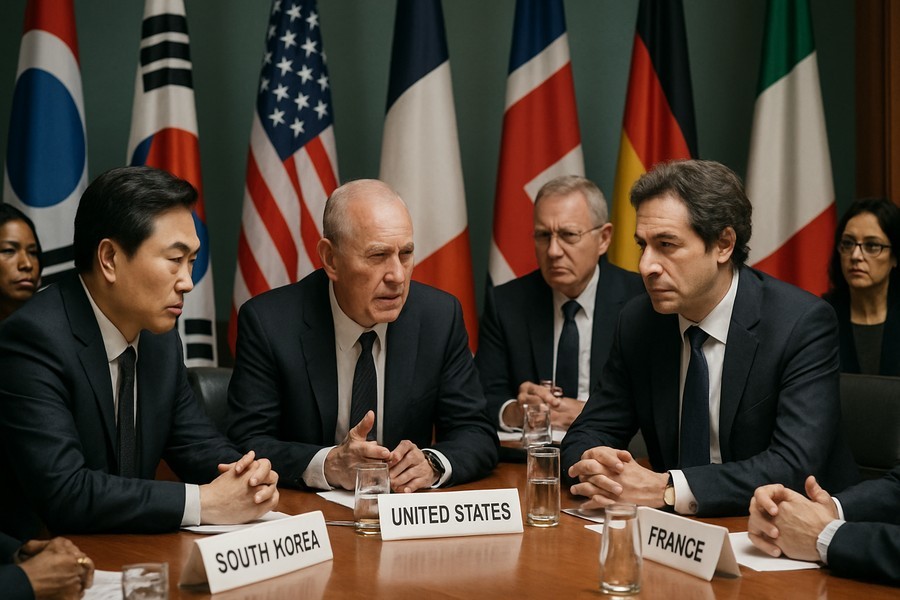
Navigating a New Global Order: The Predicament of 'Middle Powers'
Imagine a world where the balance of power is shifting back to what it was before the Second World War, leading to a significant new test for the so-called 'middle powers'.
Reflecting on US Influence
A few years back, I was invited to deliver a keynote speech at a respected journalism school. The world was still reeling from the shocking events where two planes had crashed into the twin towers. The city's pain was palpable, evident on the faces of its citizens.
In my address, I talked about my personal understanding of America's role in the world. I was born about 15 years post-World War II, in a time when Western Europe was experiencing a period of peace, security, and gradual prosperity, largely due to American efforts.
The American Contribution
The United States, with its military prowess, had emerged victorious in the western front of the war and had halted the further westward expansion of Soviet power. I also touched upon the transformative impact of the economic aid provided by the US, which allowed Europe to reconstruct its devastated economies and revive its democratic institutions.
As a young reporter, I had the privilege of witnessing the culmination of these efforts in 1989 in Prague. I stood in awe as the people demanded an end to the Soviet rule and a despised Communist dictatorship, aspiring to join the community of nations known as "the West", united by common values, led by the United States.
After my speech, a young man approached me, deeply moved by my words. He felt that America, in its time of vulnerability, needed to hear these affirmations from its international allies.
The Other Side of the Story
One of his classmates, a recent arrival from Pakistan, drew parallels between the US and Imperial Rome. He spoke about the dichotomy between the experiences of living within the protective walls of America and living on the outer fringes, where American power might not seem as benevolent. He highlighted the uneven enforcement of international laws and trade rules, pointing out that the strongest countries often sidestep these regulations when it suits them.
A Return to Great Power Politics?
There have been recent indications that America is moving away from the system of transnational bodies that it helped create to regulate international affairs. The focus seems to be shifting towards putting "America First" and using every available means - from economic sanctions to military intervention - to align smaller and weaker nations with US interests. This could signal a return to a time when the Great Powers carved out spheres of influence.
This development poses a clear threat to the 'middle powers'. As the Canadian Prime Minister aptly put it, "If you're not at the table, you're on the menu."
Reflections on the Monroe Doctrine
The so-called rules-based international order has not always seemed to apply to the Global South, or to the US and some of its allies. There have been numerous instances of American intervention in Latin America under the guise of the Monroe Doctrine. This policy, initially seen as a protection against European colonization, quickly evolved into an assertion of Washington's right to dominate its neighbors and manipulate their policies to align with American interests.
Challenges for 'Middle Powers'
Today, 'middle powers' are facing a daunting task. The post-war world order, structured around rules and laws, appears to be giving way to a system resembling the Great Power rivalries of the past. This shift, coupled with a growing distrust in traditional sources of news and information, is leading to a corrosion of popular trust in democratic institutions.
It's a stark reminder that the post-World War II order, supported by American might, may not be a permanent state of affairs. And it underscores the importance of remaining vigilant and adaptable in the face of an ever-changing global landscape.