
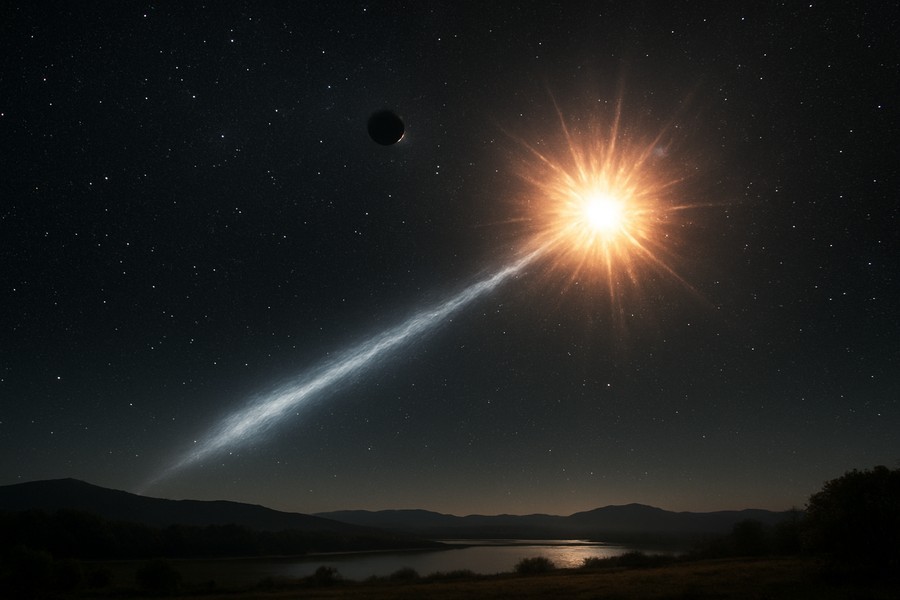
Did a Black Hole Just Detonate? An Unusual Particle Gives Us Clues
Could a particle, with energy levels that seem impossible, have hit Earth and left us with evidence of a primordial black hole explosion? This scenario could be the key to proving the existence of primordial black holes and solving the mystery surrounding the composition of dark matter, the most enigmatic substance in the universe.
The Unusual Particle
The particle in question was a neutrino, with energy levels surpassing the maximum energy of particles that the most powerful particle accelerator on Earth can produce. This is so extraordinary that no known natural cosmic event has the capacity to generate a particle of such high energy.
Now, some scientists are proposing that this highly energetic particle could have been ejected during the explosion of a special type of primordial black hole.
The Concept of Black Hole Explosions
The notion of black hole explosions revolves around the concept of Hawking radiation, a form of thermal radiation named after the physicist who first proposed its existence in 1974, Stephen Hawking. The hotter a black hole is, the faster it emits Hawking radiation, losing mass until it ultimately explodes.
However, larger black holes are colder and emit thermal radiation more slowly. Even the smallest stellar mass black holes, formed when massive stars explode into supernovas at the end of their life cycles, would take an estimated time far exceeding the universe's age to emit enough radiation to reach an explosive state.
Primordial Black Holes
Stephen Hawking also theorized the existence of another kind of black hole, not born from the death of a star but from density changes in the ultra-hot particles that filled the cosmos during its earliest moments post the Big Bang. These primordial black holes can be significantly smaller, with masses equivalent to a planet or even a large asteroid. Because of their smaller size, these black holes could emit Hawking radiation efficiently enough to explode.
The scientists who proposed this theory estimate that a primordial black hole should explode approximately once every decade. However, no such explosion has been detected so far, making primordial black holes and Hawking radiation purely theoretical. That is unless an exploding primordial black hole was detected via a different method, the true nature of which wasn't immediately recognized.
The Mysterious Neutrino
This extraordinarily energetic neutrino was detected in 2023 by a network of neutrino detectors positioned in the Mediterranean Sea. The detection of this high-energy neutrino was an incredible occurrence. The discovery could potentially confirm the existence of Hawking radiation, provide evidence for primordial black holes and new particles beyond the Standard Model, and unravel the mystery of dark matter.
However, a similar neutrino detector situated deep within the South Pole's ice, designed to detect high-energy neutrinos, didn't pick up this event. This is surprising since it has never detected a particle with even 1/100 of the energy of this neutrino. If primordial black holes explode every decade, high-energy neutrinos should frequently bombard this detector. So, where are they?
The Dark Charge Hypothesis
The scientists put forward a theory. They believe that primordial black holes with a 'dark charge' are the missing link. A 'dark charge' is a version of the electromagnetic force carried by a much heavier relative of the standard electron, a hypothetical particle called a 'dark electron'.
Primordial black holes with a dark charge would have unique properties, different from standard primordial black holes. These unique properties could explain the unusually energetic neutrino and could also solve the mystery of dark matter.
Dark Matter
Dark matter has been a challenging topic because it does not interact with electromagnetic radiation or light, unlike standard matter particles. Despite outweighing ordinary particles by a ratio of 5 to 1, dark matter remains virtually invisible and a total mystery. Primordial black holes are considered a possible candidate for dark matter.
If the dark charge hypothesis is correct, there could be a significant number of primordial black holes, which would align with other astrophysical observations and account for the missing dark matter in the universe.