
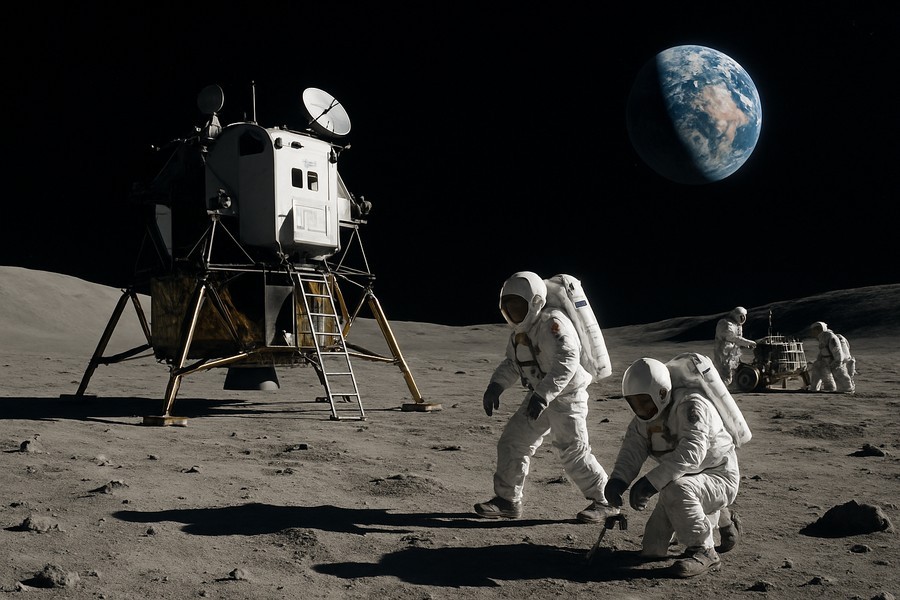
Expedited Lunar Return Plan Showcases NASA's Ambitious Approach
The space agency is already gearing up for its third mission to the moon, even as the second mission continues to make strides. This indicates a significant move towards a consistent human presence on the lunar surface. This strategy shows a growing trust in existing systems, hinting that the upcoming moon landing could happen earlier and with fewer modifications than anticipated.
Simultaneous Mission Strategy Emerges
The agency's changing method for exploring the moon shows a departure from strictly following a step-by-step process. Instead, it's adopting a concurrent phase approach designed to hasten the progress. As the second mission works on sending astronauts around the moon, teams back on Earth are deep into preparations for the third mission, which aims to land humans on the moon for the first time since the Apollo era.
This simultaneous workflow represents a change in the operational philosophy. Instead of waiting for a mission to be fully completed and analyzed post-flight, the agency is utilizing real-time data and decades of engineering knowledge to cut downtime between missions. The outcome is a more flexible program capable of quick adaptation without losing momentum.
One of the key figures in the mission described this approach as a milestone for the agency's future goals. "We can undertake—again—world-changing missions like the second lunar mission right now and get ready for the next ones at the same time," he said. This statement indicates a wider objective: not merely returning to the moon, but establishing a sustainable presence there. By shortening development timelines and overlapping mission phases, the space agency aims to sidestep the extended gaps that have historically bogged down human spaceflight programs.
Focused Improvements Over Major Overhauls
One of the most remarkable aspects of the agency's lunar mission roadmap is the minimal changes expected to be made between missions. Engineers aren't planning extensive overhauls of spacecraft or systems. Instead, they are zeroing in on targeted enhancements guided by data from the second lunar mission.
This method lessens both risk and cost. It also shows a belief in the basic structure of the rocket launch system, the lunar spacecraft, and supportive technologies. By maintaining continuity, the agency ensures that each mission directly builds upon the previous one.
The agency's flight director emphasized this point during a recent briefing. "The things that we’re going to have to improve upon for the third lunar mission are relatively small and incremental in nature, as opposed to wholesale redesigns of spacecraft subsystems," he said.
This strategy echoes practices seen in commercial spaceflight, where iterative development allows for swift improvement. Instead of pausing for years between missions, the agency is adopting a model that prioritizes continuity and steady progress. The implication is obvious: the third lunar mission isn't starting from zero. It's an evolution that could happen sooner because the foundation has already been laid.
Human Landing Systems and Launch Frequency's Role
A crucial element shaping the third lunar mission is the development of Human Landing Systems (HLS), which will transport astronauts from lunar orbit to the moon's surface. The agency is currently collaborating with multiple providers, introducing redundancy and competition that could speed up readiness.
The launch frequency, or how often these systems are tested and deployed, will play a decisive role in setting timelines. Regular launches mean quicker learning cycles, more data, and faster validation of technologies.
The importance of this dynamic was highlighted. "We’ll all have a sense of which path we’re going to go down based on launch cadence of our two HLS providers, both of which have launches coming up in the next month or less," he said. This imminent activity suggests that key decisions about the third lunar mission could be made sooner than expected. Rather than waiting years for clarity, the agency may soon have the data needed to finalize mission architecture and timelines.
The presence of multiple providers also lessens dependency on a single system, increasing resilience across the program. This diversified approach could prove essential as the agency pushes towards more ambitious lunar operations.
Aiming for a Lasting Lunar Presence
Beyond the immediate goal of landing astronauts, the third lunar mission is part of a much larger vision: establishing a permanent human presence on the moon. This includes the eventual creation of infrastructure, habitats, and possibly a lunar base that can support extended missions.
At the heart of this vision is the concept of reusability. Heavy-lift launch vehicles must be capable of flying frequently and reliably to make sustained lunar operations economically viable. The agency sees this as a cornerstone of its long-term strategy.
This was directly addressed, "A big key to our strategy—to not just return to the Moon but to stay and build a base—is the rapid reusability of heavy-lift launch vehicles. The more they get experience doing that, the more options that are available to us for the third lunar mission."
This emphasis aligns the agency more closely with commercial spaceflight trends, where reusability has dramatically reduced costs and increased launch frequency. Applying these principles to lunar missions could transform what is currently a series of isolated expeditions into a continuous presence.
The success of the third lunar mission will therefore extend far beyond a single landing. It will serve as a proof of concept for sustained exploration, shaping how humanity operates beyond Earth for decades to come.