
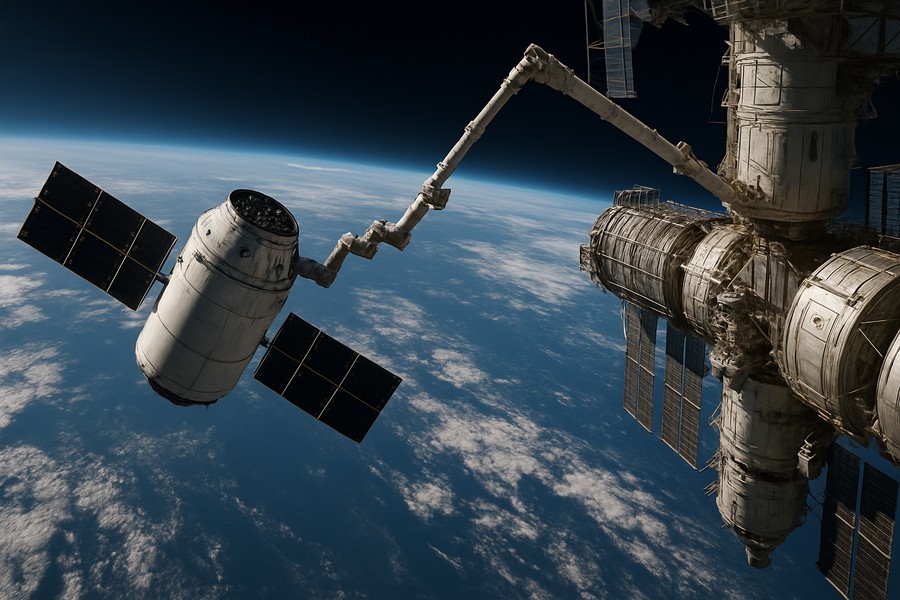
Unmanned Spacecraft Set to Leave International Space Station
An unmanned spacecraft, packed with roughly 12,000 pounds of supplies, scientific equipment, and other cargo, is ready to bid farewell to the International Space Station this Friday. This spacecraft, which belongs to Japan's national space agency, has been of great service to the station and its international partners.
Live coverage of this event will be available across various online platforms. Viewers can tune in to watch the spacecraft's release in real time, with coverage starting 15 minutes prior to the event.
Preparations for Departure
Preparations for the spacecraft's departure will begin a day earlier. The space station’s robotic arm, Canadarm2, will detach the spacecraft from its current position on the Earth-facing port of the station's Harmony module. It will then be maneuvered into the right position for release. However, there will be no live coverage of this stage of the process. An astronaut named Chris Williams will be monitoring the systems of the spacecraft as it undocks and departs.
Post-Departure Plans for the Spacecraft
Once released, the spacecraft will stay in orbit for over three months. During this time, it will serve as a scientific platform for various experiments. After receiving a deorbit command, the spacecraft will dispose of several thousand pounds of waste by reentering Earth’s atmosphere. Here, it will burn up harmlessly, thus eliminating the trash.
Spacecraft's Journey to the Space Station
The spacecraft journeyed to the space station after its successful launch from Japan's Tanegashima Space Center. It arrived at the space station a few days later and has been a valuable contributor to the station's operations.
The International Space Station: A Hub of Continuous Human Presence and Research
For over 25 years, the International Space Station has been a hub of continuous human presence and research. It has led to significant advancements in scientific knowledge and breakthroughs that could not have been achieved on Earth. The station is a crucial testing ground for understanding and addressing the challenges of prolonged space travel. It also plays a key role in expanding commercial opportunities in low Earth orbit.
As commercial companies focus on providing human space transportation services and destinations, part of a robust low Earth orbit economy, the space agency is channeling its resources towards deep space missions to the Moon. This is part of the Artemis campaign, which is preparing for future manned missions to Mars.
For the latest updates, images, and features from the space station, follow their social media pages.
To know more about the research and operations at the International Space Station, visit their official website.