
Sending Humans Back to the Moon: The Next Chapter
The dream of returning humans to the Moon is inching closer to reality. The focus is not just on making a brief visit, but in establishing a lasting human presence on its surface. A significant part of this ambitious plan involves the upcoming mission that will set the stage for the first crewed lunar landing since the historic Apollo missions.
However, before the lunar landing can occur, a crucial mission has been scheduled to ensure everything is in place. This mission, a precursor to the actual lunar landing, won't be landing on the Moon. Instead, it will serve as a critical test run for the actual moon landing planned for a few years down the line.
Mission Details: What's the Plan?
Unlike the Apollo missions that took astronauts directly to the lunar surface, the upcoming missions will involve more complex steps. The subsequent missions, following the initial test flight, will focus on constructing a small space station orbiting the moon. This will not only facilitate future moon landings but will also accommodate additional sections and host robotic rovers to operate on the lunar surface.
As the plan unfolds, more nations are expected to join in, contributing to the development and maintenance of a human outpost on the Moon. This international collaboration aims to sustain human life and work in and around the Moon for extended periods.
The Journey Begins: Rocket Transport
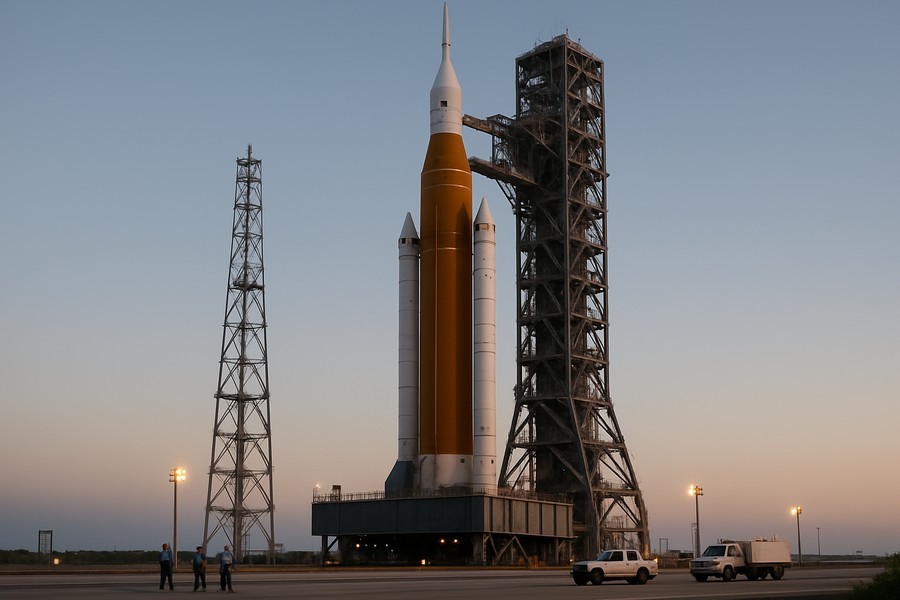
Recently, a rocket was seen exiting a vehicle assembly building in Florida, marking the beginning of its journey towards the launch pad. The rocket now embarks on a four-mile trek to the launch pad, a journey followed by many with keen anticipation.
Preparations for the Moon Mission
While the exact date of lift-off remains uncertain, the preparations for the mission are well underway. Once the astronauts are securely in orbit, they will test the spacecraft's handling capabilities. This involves manually steering the spacecraft in Earth's orbit to practice alignments for future Moon landings.
The crew will also journey to a point thousands of kilometers beyond the Moon to examine the spacecraft's life-support, propulsion, power, and navigation systems. They will also serve as medical test subjects, sending back data and imagery from deep space, working in a small cabin under weightless conditions. Despite increased radiation levels compared to those on the International Space Station, the crew's safety remains assured.
The return to Earth will involve a turbulent re-entry through the atmosphere and a splashdown in the Pacific, off the west coast of the U.S.
A Journey of Discovery
The mission commander has expressed excitement about the journey, noting that the spacecraft will traverse extensive areas of the Moon that have never been mapped by previous missions. The crew is expected to make observations that could answer some of humanity's most profound questions. Can we answer the question "Are we alone?" by visiting Mars in the future? This mission could certainly provide the first step towards finding that answer.
Preparing for Launch
A gigantic rocket, designed to carry astronauts around the Moon, is set to be transported to its launch pad. The journey from the assembly center in Florida to the launch pad is approximately four miles. The complete operation is expected to take around 12 hours.
This rocket, part of a larger mission plan, is not set to launch into space until early February. The ten-day mission will potentially take its astronauts further into space than anyone has been before. It aims to pave the way for an eventual human landing on the lunar surface, something not achieved since the Apollo missions of the 1960s and 70s.
