
A Cosmic Game of Billiards: How Spacecraft's Collision Alters Asteroids' Path
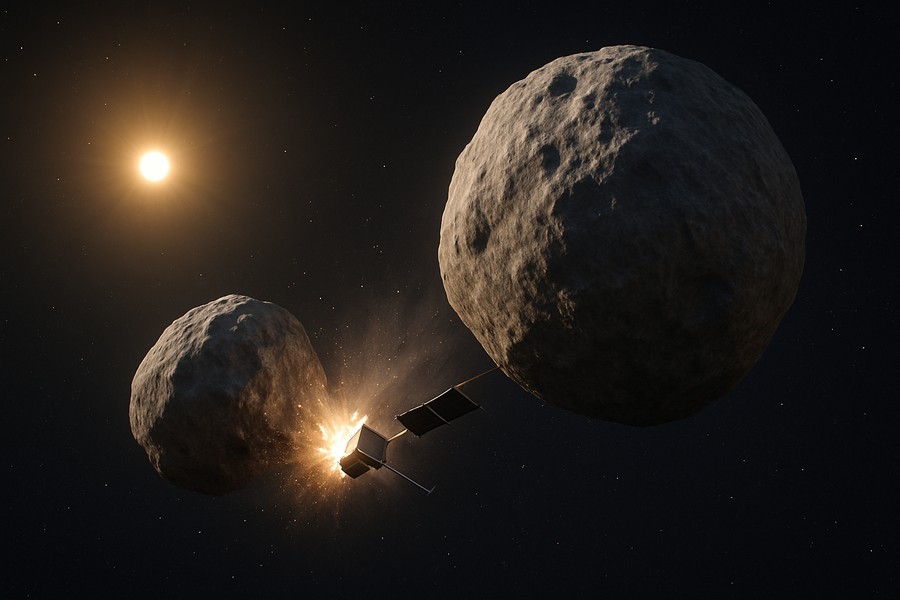
A recent experiment has demonstrated that it's possible to alter the orbit of asteroids. This was achieved when a spacecraft was deliberately crashed into a small asteroid called Dimorphos. The test was conducted to see if we could defend our planet from potentially destructive space rocks. Remarkably, the experiment was successful, resulting in changes to the orbits of both Dimorphos and a larger asteroid, Didymos.
Dimorphos and Didymos are a binary pair of asteroids, meaning they orbit around one another while also circling the sun. Changes to the orbit of one asteroid naturally affect the other.
Understanding the Impact on Orbital Speed
The data collected after the spacecraft collision revealed that the time it takes for Didymos and Dimorphos to complete one solar orbit - about 770 days - decreased by less than a second. This change in their orbital speed was about 11.7 microns per second or 1.7 inches per hour.
While this change might seem small, it's significant in the context of space. Over time, even such a tiny alteration in an asteroid’s motion can determine whether it collides with or misses our planet.
The Aftermath of the Collision and its Implications
Neither Didymos nor Dimorphos pose any threat to Earth. But their binary system provided a perfect testing ground to assess how effectively a spacecraft could be used to alter the path of celestial bodies.
To evaluate the success of the test, researchers had to measure how the impact changed the orbits of Dimorphos and Didymos.
Didymos is shaped like a spinning top, and is believed to be a rubble pile asteroid, which is essentially a loose collection of dust and rocks. Dimorphos is also a rubble pile and is likely formed from debris that gathered after being shed by Didymos.
When the spacecraft slammed into Dimorphos, it ejected a massive cloud of debris into space, estimated to be 35.3 million pounds. Even though the space rock only lost 0.5% of its mass, the debris released packed a greater punch than the spacecraft's impact. As a result, the pair of asteroids now orbit the sun faster.
Studying the Asteroids' New Orbits
The study found that the force of the ejection increased the speed at which the two asteroids orbit the sun, reducing their total orbit time by 0.15 seconds.
To measure this change, astronomers relied on ground-based observations of Didymos and data from when the asteroid passed directly in front of stars. This method, known as stellar occultations, enables scientists to measure an asteroid’s direct position, speed, and shape.
However, observing a star blink for a fraction of a second as an asteroid passes in front of it from our perspective on Earth is incredibly challenging. The study's results were dependent on 22 stellar occultations, which were taken by volunteer astronomers around the world.
Preparing for Future Asteroid Threats
More observations and measurements of the effect on the asteroids will be shared once the European Space Agency's follow-up mission arrives in orbit around the asteroid system later this year. The mission will capture and share new images of Dimorphos.
Meanwhile, NASA is developing a mission to spot dark, risky asteroids that have remained nearly invisible from Earth-based observatories. Identifying potentially dangerous asteroids and understanding how a small change in orbit can lead to a significant deflection is crucial for defending our planet.
If an asteroid that poses threats to our world is found with enough time to deflect it, a kinetic impactor like the one used in this experiment could be sent to nudge the space rock, or its companion, into a safer orbit that doesn't intersect with Earth's.