
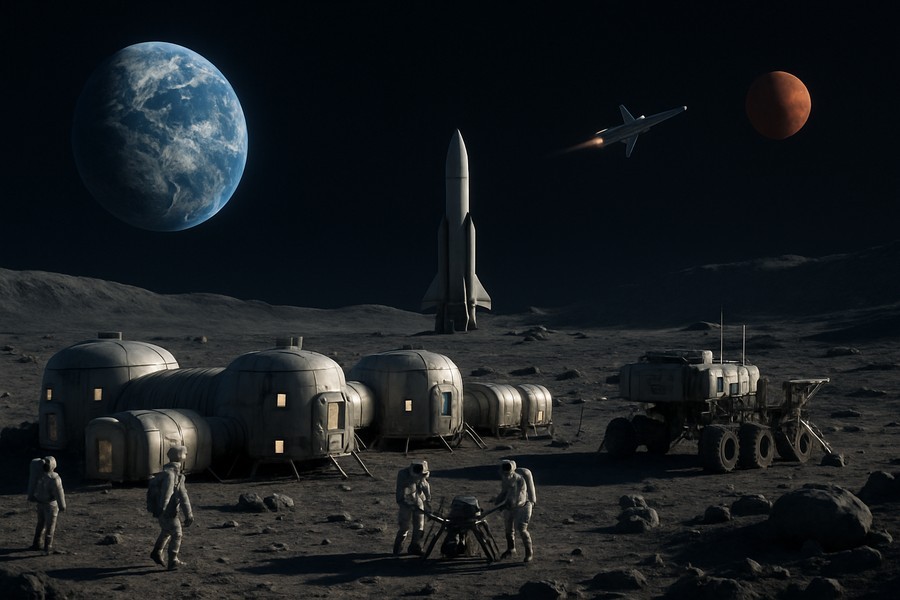
Moon Base and Mars Spaceship: $20bn Investment Plan Unveiled
Plans for a major revamp of lunar and Martian exploration strategies have been revealed. This includes abandoning earlier plans for a lunar-orbit space station and instead, allocating a whopping $20bn over the coming years to construct a permanent base on the moon's surface. The plan also involves progressing with the concept of dispatching a nuclear-powered spacecraft to Mars.
Strategy Overhaul and New Appointments
The new strategy was laid out during a meeting held in the nation's capital, with stakeholders, contractors, and government officials who are integral parts of the Artemis programme. The new leadership, which came into power in December under the appointment of the US President, stated that these modifications form a crucial part of a broader revamp of the long-term lunar and Martian strategy.
There will be increased robotic missions to the moon, and preparations for establishing nuclear power on the lunar surface will be laid out.
Moon Base and Robotic Missions
The proposed moon base is planned to aid in maintaining a long-term human presence on the lunar surface. Robotic missions are anticipated to assist in preparing the site, testing the requisite technologies, and initiating the construction of infrastructure before the return of astronauts later in the decade.
Nuclear-Powered Spaceship to Mars
Plans were also revealed to launch a spaceship, named Space Reactor 1 Freedom, before the end of 2028. The mission's primary aim is to showcase nuclear electric propulsion in deep space en route to Mars. The spaceship is designed to transport helicopters to the Red Planet, much like the Ingenuity robotic test helicopter that flew alongside a rover, which was a significant step towards transferring nuclear propulsion technology from lab tests to operational space missions.
The Ingenuity helicopter was the first-ever aircraft to achieve powered, controlled flight on another planet. It journeyed to Mars attached to a rover and successfully landed in February 2021.
Repurposing Lunar Gateway
The Lunar Gateway station, a planned space station in lunar orbit being developed with various contractors and international partners, was expected to serve as a base where astronauts could stay and operate before heading to the Moon's surface. However, this plan has been revised, and some of the Gateway components will now be used on the surface instead.
The decision to repurpose the Lunar Gateway to create a base on the moon's surface brings a degree of uncertainty about the future roles of key partners in the Artemis programme, including Japan, Canada, and the European Space Agency. These entities had previously agreed to supply parts for the orbital station.
The changes to the flagship Artemis programme are reshaping billions of dollars' worth of contracts and come at a time when the United States faces increasing competition from China, which has set its sights on landing astronauts on the moon by 2030.
Looking back at the Artemis Programme
Begun in 2017, during the first term of the current president, the Artemis programme envisions regular lunar missions as the long-awaited sequel to the initial moon missions of the Apollo programme that ceased in 1972.