
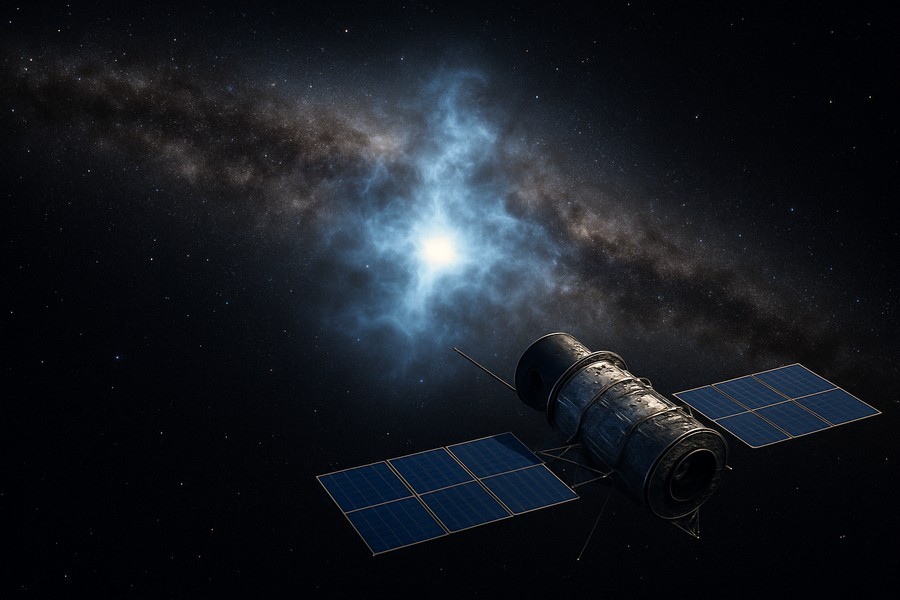
Uncovering the Fiery Past of Our Galaxy's Enormous Black Hole
Our galaxy's supermassive black hole is usually seen as a sleeping giant. However, recent revelations suggest that this wasn't always the case. This enormous black hole, known as Sagittarius A*, has reportedly had a history of violent outbursts over the past millennium.
These unexpected discoveries, made possible by an international X-ray spacecraft, could revolutionize our knowledge of how these enormous black holes evolve. These celestial bodies, with masses equivalent to millions or billions of suns, play a significant role in shaping the galaxies that orbit around them.
Scientists Stunned by Discovery
The findings have left astronomers in awe. The project's lead scientist expressed his surprise, stating, "Nothing in my professional training as an X-ray astronomer had prepared me for something like this. This is an exciting new capability and a brand-new toolbox for developing these techniques."
All black holes are completely dark, surrounded by areas known as event horizons where gravity is so strong that not even light can escape. However, surrounding matter can become superheated due to the intense gravity of these space giants, causing it to shine brightly and release powerful flares. Sagittarius A*, which has a mass equivalent to 4 million suns, was not previously known to have produced such emissions.
A Turbulent History Unveiled
The team unveiled the black hole's turbulent past when they directed their X-ray spacecraft towards a massive gas cloud, known as a molecular cloud, near the center of our galaxy. They studied the X-rays it emitted in meticulous detail. This investigation showed that the molecular cloud was behaving like a cosmic mirror, reflecting X-rays previously released by Sagittarius A* outbursts.
The spacecraft's sensitivity enabled the team to measure the energy and shapes of X-ray emissions with unprecedented accuracy. This also revealed the movement of the cloud and allowed them to rule out other possible explanations for the cloud's X-ray glow, including cosmic rays.
A New Era of Space Exploration
This discovery also demonstrates the spacecraft's exceptional ability to study the cosmos in such fine detail that it can reveal the universe's hidden history. The team of scientists feels fortunate to have the opportunity to work with this data in a completely new way.
As the project's lead researcher concluded, "One of my favorite things about being an astronomer is realizing I’m the first human to ever see this part of the sky in this way."
The team's research will soon be published in a renowned scientific journal dedicated to astrophysics.