
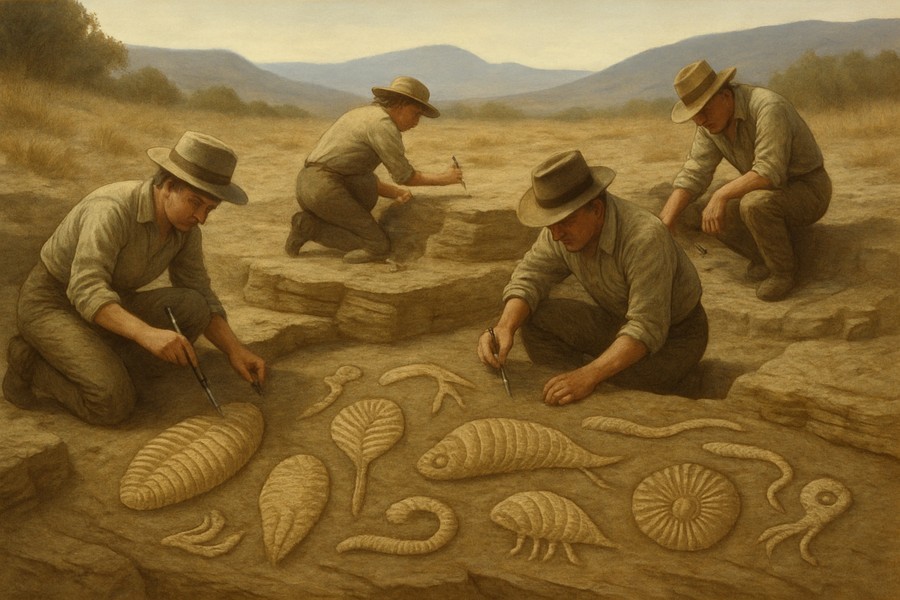
Uncovering Earth's Ancient Past: Diverse Animal Life Before the Cambrian Period
Understanding the origins of animal life on Earth can be a bit like trying to solve a jigsaw puzzle with missing pieces. Most of the animal groups we know today first appeared during the Cambrian period, a time of rapid evolution and diversification. However, evidence suggests some types of animals may have existed before this era, during a time known as the Ediacaran period.
Unveiling the Mystery of Ediacaran Creatures
The Ediacaran period is known for its mysterious and unfamiliar species, many of which do not seem to have any modern-day equivalents. The disappearance of these creatures from later geological records has led some to believe they were wiped out in a mass extinction event that paved the way for the Cambrian explosion. However, recent fossil discoveries in China challenge this theory, revealing a mixture of Cambrian and Ediacaran species coexisting together.
Discovering a World Beyond Algae
The newly discovered fossils were found near Fuxian Lake, south of Kunming, in rocks belonging to the Dengying Formation known for its Ediacaran deposits. While the site was previously renowned for its abundance of algae, the latest findings revealed an astonishing diversity of over 700 species, dubbed the Jiangchuan Biota. These fossilized remnants, typically one to two centimeters in size, provide a wealth of detail, even preserving internal organs in some cases.
Life on the Ancient Shoreline
The fossils were likely rapidly buried in sediment, in what appears to have been a coastal environment slightly deeper than the low tide mark. This environment is reminiscent of the one that preserved the famous Burgess Shale Cambrian fossils. However, the Jiangchuan Biota stands out with its mix of Cambrian and Ediacaran species.
Uncovering an Eclectic Mix of Ancient Life
The Jiangchuan Biota includes cnidarians, radially symmetric organisms similar to present-day jellyfish. Other fossils resemble comb jellies, organisms known to have been present by the Cambrian period. The discovery of these species in the Jiangchuan Biota pushes back the timeline of their existence, revealing some of their features existed earlier than previously thought.
Distinctive creatures similar to mackenziids, soft-bodied organisms from the Cambrian period, were also discovered. Interestingly, the Jiangchuan Biota also features fossils of worms. These creatures are bilaterian, meaning they have left/right symmetries, a characteristic shared by many modern-day animals, including humans. The discovery of 185 individual worm fossils in the Jiangchuan Biota strengthens the case for bilaterians living before the Cambrian period.
Filling in the Gaps of Evolution
The Jiangchuan Biota provides compelling evidence that the shift from the Ediacaran to the Cambrian period was more gradual than previously thought. However, it raises questions about why such a significant gap appeared to exist between these two periods. One explanation could be the changing conditions that preserve carbon-rich materials, leading to the preservation of a smaller biosphere where the largest creatures were only a few centimeters long.
These recent findings shed new light on the complexity and diversity of animal life prior to the Cambrian period, offering fascinating insights into Earth's ancient past. As we continue to explore and uncover the mysteries of our planet's history, we grow ever closer to completing the puzzle of life's origins.