
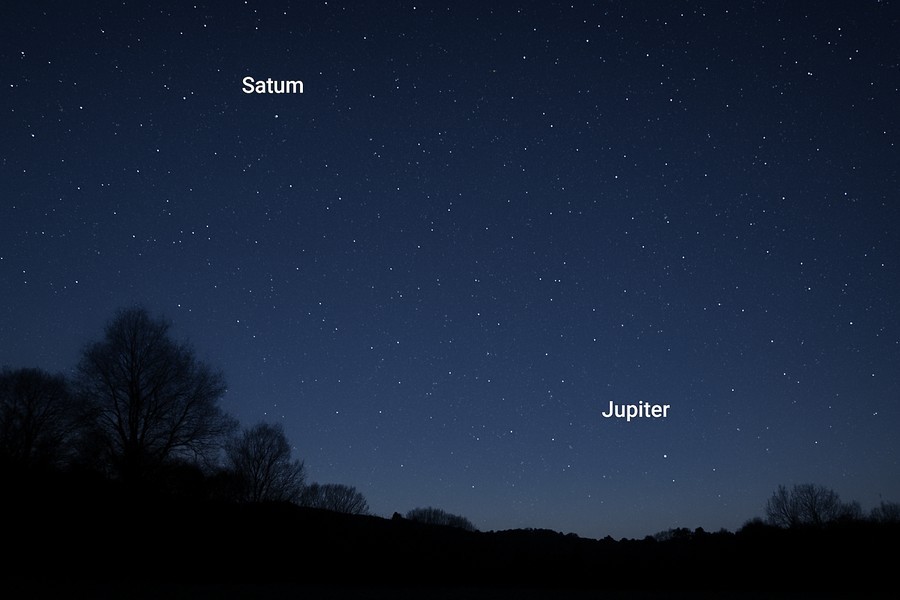
Enjoy a Stellar View with January's New Moon
If you're a fan of stargazing, you're in luck! The new moon this January brings us spectacular views of Jupiter, Saturn, and the winter stars. The new moon, which is when the sun and moon align on the same celestial longitude, is an exciting time for astronomers and stargazing enthusiasts everywhere. The moon's illuminated side is turned away from us during this phase, making it invisible against the backdrop of the sun. However, this darkness allows us to observe fainter stars and celestial bodies with better clarity.
Spotting Saturn and Jupiter
On the night of the new moon, Saturn and Jupiter, two of our solar system's giant planets, will be visible to the naked eye. Around 6 p.m., Saturn will be approximately 37 degrees above the southwestern horizon. As the sky darkens, you'll also be able to spot Jupiter, which will be about 21 degrees high in the east. Jupiter's brightness makes it easily distinguishable from surrounding stars, making it one of the highlights of the night.
Unfortunately, Mercury, Venus, and Mars will be too close to the sun to observe during this time. But don't worry, they will come out of the solar glare in the weeks following the new moon. So, keep your eyes peeled!
Stunning Constellations in the Winter Sky
Winter constellations present a breathtaking sight for Northern Hemisphere observers. Orion (the Hunter), Gemini (the Twins), Taurus (the Bull), Canis Minor (the Little Dog), and Auriga (the Charioteer) are all visible in the night sky. Sirius, the alpha star of Canis Major, the Big Dog, and the brightest star in the sky, can also be spotted low in the southeast.
Orion can be identified by the three stars that make up his belt. If you look slightly up and to the left of the belt, you can spot a bright reddish-orange star, Betelgeuse, marking one of Orion's shoulders. Above and to the right of Betelgeuse is Bellatrix, his other shoulder. On the right side of Orion's Belt, about the same distance from Mintaka as Betelgeuse is from Alnitak, is a bright blue-white star, Rigel.
Since the night will be moonless, you can trace a group of faint stars that is Orion's sword, and in that group, you might be able to spot the Orion Nebula, especially if you are in a dark-sky location away from city lights.
Navigating the Night Sky
Spotting constellations isn't always easy, but using the stars as a guide can help. For example, you can use Jupiter to orient yourself. The two stars to the left (north) of Jupiter are Castor and Pollux, with Pollux being the one closer to the horizon. If you draw a line through Jupiter and Pollux northwards, you'll reach the Big Dipper, a group of stars that is part of Ursa Major, the Great Bear.
For Southern Hemisphere observers, January is when Puppis, Carina, and Vela, the three constellations that make up the Argo, the famous ship of Jason and the Argonauts, are prominent. You can still use Jupiter to orient — Pollux will appear to be directly below the planet, and Procyon is to the right of Jupiter and above it.
So, grab your binoculars, find a comfortable spot, and get ready to witness the celestial magic of a new moon night!