
The Balancing Act: Cutting Carbon Emissions While Protecting Biodiversity
As the world grapples with climate change, it's clear that reducing carbon emissions alone isn't enough. We must also actively remove carbon dioxide from the atmosphere. But, this process is not without its challenges and potential trade-offs.
Land Use and Carbon Removal
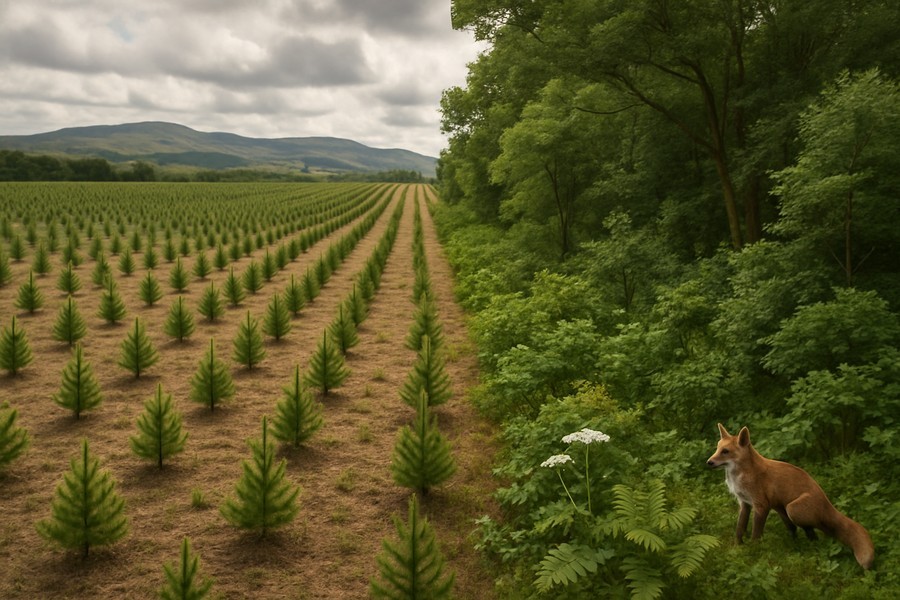
Several carbon removal strategies require significant land use. For instance, planting trees or cultivating crops for bioenergy are land-intensive endeavors. If implemented on a large scale, these strategies could disrupt millions of square kilometers of land and potentially harm biodiversity if not properly managed.
A team of climate scientists recently conducted an in-depth study to explore the balance between climate action and biodiversity conservation. They wanted to understand possible conflicts and synergies between carbon removal efforts and conservation goals.
Decoding Decarbonization Scenarios
The scientists analyzed various decarbonization scenarios, which offer insights into how our energy use, economy, and land use patterns need to change to reach ambitious climate goals. They investigated how land is allocated for carbon removal strategies in these scenarios and the potential impact on biodiversity conservation.
By comparing global maps of future land use for carbon removal with biodiversity maps, the team identified areas where these two objectives might intersect. They discovered that in many overlapping areas, carbon removal strategies could harm biodiversity. For instance, in ecosystems like savannas and grasslands, which typically have limited forest cover, planting trees and energy crops could disrupt habitats.
However, the study also found that strategic placement of land-intensive carbon removal strategies could prevent negative impacts and potentially even enhance biodiversity.
The Biodiversity Challenge
Biodiversity has been declining at a rate of 2%-6% every decade for the last 30-50 years due to factors like resource extraction, climate change, pollution, and invasive species. Biodiversity is crucial for functions like pollination of food crops and regulation of water and nutrient cycles.
To counter this, a landmark biodiversity conservation agreement was set in 2022 with a goal to drastically reduce the loss of high biodiversity areas by 2030. Yet, the agreement doesn't provide a clear definition of high biodiversity areas.
In their study, the team focused on climate refugia, or areas where climate change is relatively slow, providing a safe haven for various species. They also considered biodiversity hotspots, which are areas rich in unique and rare species. Both these types of areas require careful attention to prevent human disturbances and curb global biodiversity loss.
Carbon Removal in High Biodiversity Areas
The study included various scenarios, from current policy plans to ambitious strategies aiming to limit global warming to 1.5°C. The results indicated that land-intensive carbon removal strategies could potentially impact up to 13% of global climate refugia areas. While not problematic in every instance, there are numerous areas where these strategies could be detrimental to ecosystems.
For instance, in western Africa, the study revealed overlap between significant biodiversity areas and future production of energy crops. This could be problematic given that the Global Biodiversity Framework aims to prevent harmful land use changes.
Planning for Biodiversity
Proper planning and site selection for carbon removal efforts are crucial. The study identified several biodiversity areas where carbon removal strategies could potentially benefit ecosystems.
For example, restoring forests in degraded areas to remove carbon could form green corridors, reconnecting fragmented habitats and benefiting biodiversity. Carbon removal strategies could also help mitigate the loss of biodiversity areas due to warming, preserving vital habitats.
However, it's essential that carbon removal interventions be tailored to the local context to avoid adverse effects.
In the end, the most effective strategy to limit global warming, reduce the need for carbon removal, and lower related risks to biodiversity is deep and rapid reduction in emissions.