
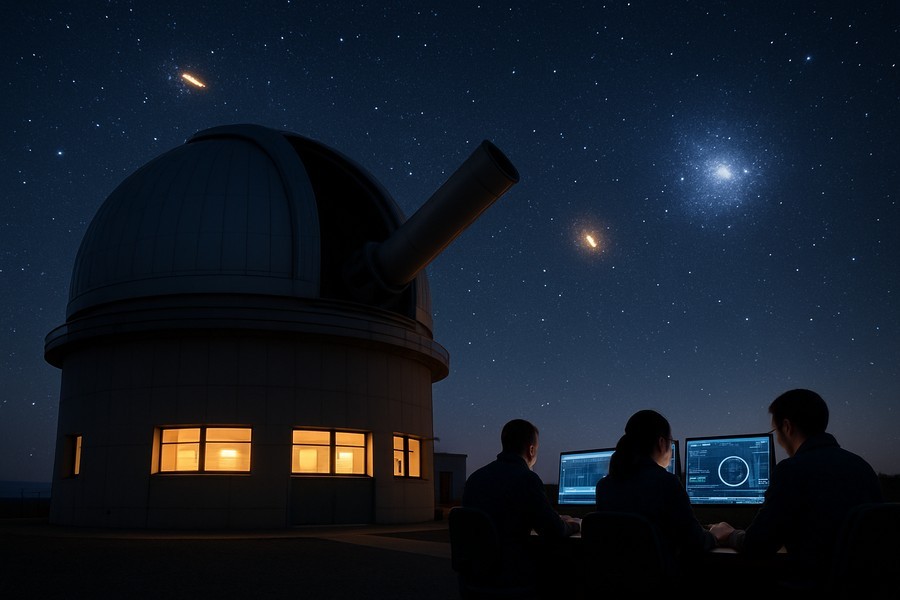
Revolutionary Observatory Unleashes Real-Time Star Gazing System
The revolutionary observatory, backed by two U.S. governmental agencies, has started issuing real-time alerts about astronomical events. In a single night, the observatory circulated 800,000 notifications about new asteroids, exploding stars, and other celestial changes. This marks the beginning of a system projected to issue up to seven million alerts every night.
Highlights of the First Alerts
Among the first round of alerts, there were notifications about supernovae, variable stars, active galactic nuclei, and asteroids. These alerts mark one of the final steps before the observatory embarks on its Legacy Survey of Space and Time (LSST) later this year. During the LSST, the observatory will scan the Southern Hemisphere sky every night for ten years, capturing every visible change with the help of the largest digital camera ever made. The alerts will document the numerous scientific discoveries the observatory is expected to make through its time-lapse record of the Universe. In the first year of the LSST, the observatory is projected to capture images of more objects than all other optical observatories combined in human history.
These alerts will open the door to numerous discoveries in astronomy, astrophysics, and cosmology. Despite the night sky appearing calm and unchanging to the casual observer, it is abuzz with motion and transformation. Each alert signifies a change in the sky since the observatory last observed it — a new source of light, a star that brightened or dimmed, or an object that moved. With these alerts, scientists will have a better chance of catching supernovae in their earliest moments, discovering and tracking asteroids to gauge potential threats to Earth, and spotting rare interstellar objects as they speed through the Solar System. The data can then be used to better understand dark matter, dark energy, and other unknown aspects of the Universe.
Enabling Real-Time Discovery
The alert system of the observatory was designed in such a way that anyone could identify interesting astronomical events with enough notice to quickly obtain time-critical follow-up observations. This required years of innovative work in image processing algorithms, databases, and data orchestration. The near-real-time public nature of the observatory’s alert system enables scientists using other ground and space-based telescopes around the world to coordinate follow-up observations like never before. This collaboration will enable quick and detailed studies of unfolding phenomena.
Revolutionizing Observations with Advanced Technology
Located in Chile, the observatory is equipped with the largest digital camera ever built, capable of detecting faint and distant objects in the Universe. Every 40 seconds during nighttime observations, the observatory captures a new region of the sky. It then sends the data on a seconds-long journey from Chile to the U.S. for initial processing. The observatory’s data management system automatically compares it to a template made from previous images of the same region. This comparison allows it to detect the slightest variations and generate a public alert within a record two-minute interval.
Interpreting the Massive Data Flow
To interpret the enormous amount of data from the observatory's alert stream, scientists rely on a network of intelligent software platforms known as brokers. These systems use machine learning algorithms to filter, sort, and classify the alerts before distributing them to scientific teams and observatories. These brokers also cross-reference alerts with data from multi-wavelength astronomical catalogs. Some of them specialize in specific types of objects and events. Identifying these events early allows scientists to provide tailored analysis and respond more quickly.
Accessible to All
The alerts from the observatory are available to everyone, from professional researchers to students and citizen scientists. Alerts can be accessed through any of the seven official community brokers, as well as two downstream services. These services form an international network that enables prompt, real-time data exploration from anywhere on Earth. Furthermore, through collaborations with platforms like Zooniverse, the observatory will empower the global community to classify cosmic events and contribute directly to discovery.