
Revolutionary Golden Spheres Could Enhance Solar Energy Capture
Small, shiny golden orbs are being engineered to harness more of the sun's power.
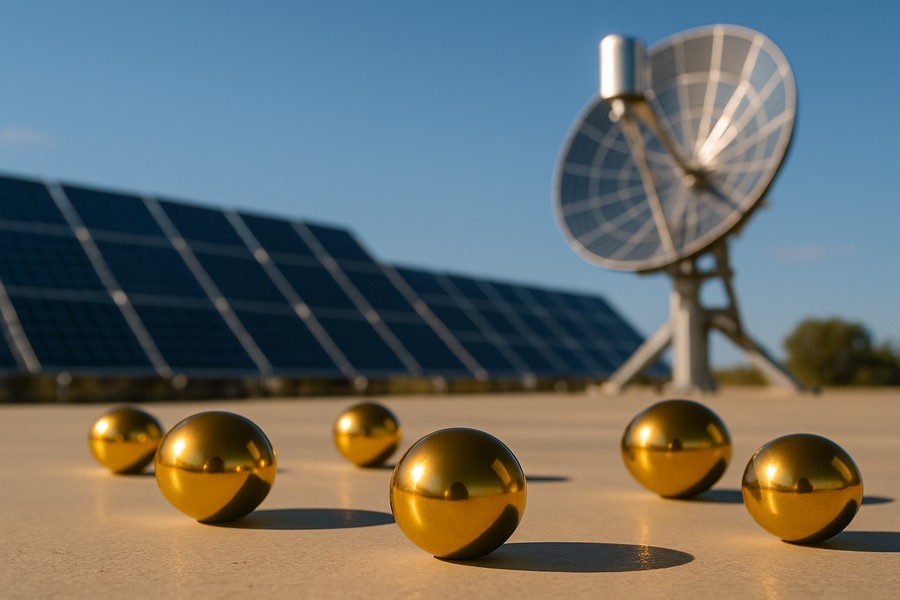
These innovative golden orbs, known as 'supraballs' by their creators, have the remarkable ability to trap a large portion of sunlight's wavelengths. This includes both visible light and near-infrared.
Boosting Solar-Thermal Systems
The scientists believe that these supraballs could revolutionize solar-thermal systems. Solar-thermal systems work by turning sunlight into heat energy, which is then used by a thermoelectric generator to produce electricity.
Seungwoo Lee, a member of the research team, expressed hope that this new coating technology could significantly reduce the barriers to achieving highly efficient solar-thermal and photothermal systems in real-world applications.
When put to the test, the combination of supraball films and a generator supported the researchers' theories. They were able to convert the enhanced light collection into increased energy production. Interestingly, such generators are commonly used in harsh environments, such as space missions and radioactive settings. They operate by collecting waste heat from other processes.
Supraballs: The Future of Solar Industry?
The solar industry is continually seeing new advancements, and these golden spheres, which resemble miniature suns, could be the next big thing.
At present, homeowners can harness the sun's abundant power with the help of rooftop panels. This technology is a great way to cut electricity costs, especially as prices continue to rise. There are even tools available to help you find the best panels for your needs, along with installation estimates and comparisons.
The team behind the supraball research referred to their discovery as a "paradigm-shifting" development, potentially paving the way for the next generation of solar thermoelectric, photothermal, and thermal management technologies.
How Are Supraballs Made?
The supraballs are created by grouping together gold nanoparticles to form films. The diameter of these films can be adjusted to capture the maximum amount of solar energy. The researchers used computer simulations to refine the design.
According to the research findings, the supraballs should be able to absorb more than 90% of sunlight's wavelengths.
Testing the Supraballs
The researchers then developed a film of gold supraballs by drying a liquid solution containing these structures on the surface of a commercially available thermoelectric generator. This was done in ambient room conditions, with no need for clean rooms or extreme temperatures.
When tested under an LED solar simulator, the supraballs, when paired with a generator, absorbed about 89% of the sunlight's wavelengths.
While sunlight contains a great deal of energy, the current technology for capturing solar power doesn't harness as much as it potentially could.
The Environmental Impact
Increasing the utilization of solar energy can drastically reduce our dependence on burning fossil fuels for power, which leads to harmful air pollution.
Home solar systems are already effectively converting sunlight into electricity without the need for a generator. Although these systems may cost $30,000 or more, they have a long lifespan and can pay for themselves several times over through energy savings.
Adding a battery storage system can be a great investment, allowing homeowners to store cheap and abundant solar energy. This stored energy can be used during power outages, to charge electric vehicles, and to gain independence from the grid.
If these golden orbs prove successful, they could soon be a key component in harnessing renewable energy. As Lee stated, these supraballs offer a simple way to harvest the full solar spectrum.