
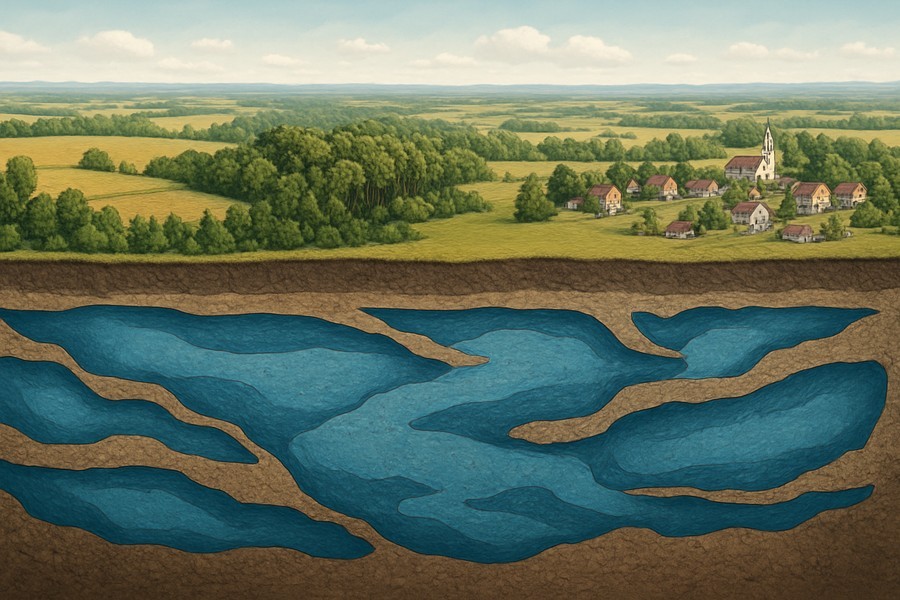
New High-Resolution Map Unveils America's Hidden Water Treasure
Unearthing the mysteries of the Earth's water resources is no easy task, especially when it comes to groundwater. While we can observe surface water with relative ease, measuring groundwater, which is hidden deep beneath the surface, is a more complex task. It's akin to keeping track of a savings account without knowing the balance or the monthly deposits.
However, a recent high-resolution map has provided the most accurate estimation yet of America’s groundwater resources. This map reveals that there are approximately 306,500 cubic kilometers of groundwater in the contiguous United States - the equivalent of filling the Great Lakes 13 times over!
A Groundbreaking Approach
The previous methods to estimate groundwater relied largely on observations from wells. However, this approach has its limitations. Wells are not regularly measured, and they are more common in areas with abundant groundwater, which skews the data. Plus, a well represents just a single data point, while the water table depth can vary greatly over short distances.
The newly developed map is a significant improvement over past efforts. The map was created using a more sophisticated method, combining direct well measurements with satellite data, as well as information about precipitation, temperature, hydraulic conductivity, soil texture, elevation, and distance of streams. The data was then used to train a machine learning model, which was able to sort through a million measurements quickly and efficiently.
High-Resolution Data Makes the Difference
To illustrate the importance of high-resolution data, the team demonstrated what would happen if they reduced the resolution of their map from 30 meters to 100 kilometers – a resolution common in many global hydrologic models. The more pixelated map estimated just over 252,000 cubic kilometers of water, underestimating the quantity by 18% compared to the high-resolution map.
Besides identifying groundwater quantities, the map also provides valuable insights into known groundwater sources. For example, it shows that about 40% of the land in the contiguous United States has a water table depth shallower than 10 meters. This indicates a strong connection between groundwater, plant, and the land surface.
A Silver Lining to Machine Learning Bias
Machine learning is often criticized for its bias, but in this case, it played a beneficial role. Early groundwater estimates were simplistic, failing to account for hydrogeology or human water extraction activities. The machine learning model, however, was able to incorporate this information because the data used to train it included evidence of groundwater pumping.
As a result, the map implicitly learned the pumping signals and the human depletion signal, which turned the bias usually associated with machine learning into a positive feature.
A Tool for the Future
The researchers hope that this new map can serve as a valuable resource for regional water management decision-makers and farmers making decisions about irrigation. They also hope it raises awareness about the omnipresence of groundwater. Whether it's 300 meters deep or just a meter below the surface, there's water beneath our feet everywhere.
