
Mysterious Ancient Black Hole Defying Cosmic Rules
An ancient black hole known as ID830 appears to be doing the impossible, growing faster than the cosmic "speed limit" and producing intense X-ray and radio wave emissions simultaneously. Both of these behaviors were believed to be impossible based on existing theories, making this black hole a fascinating anomaly.
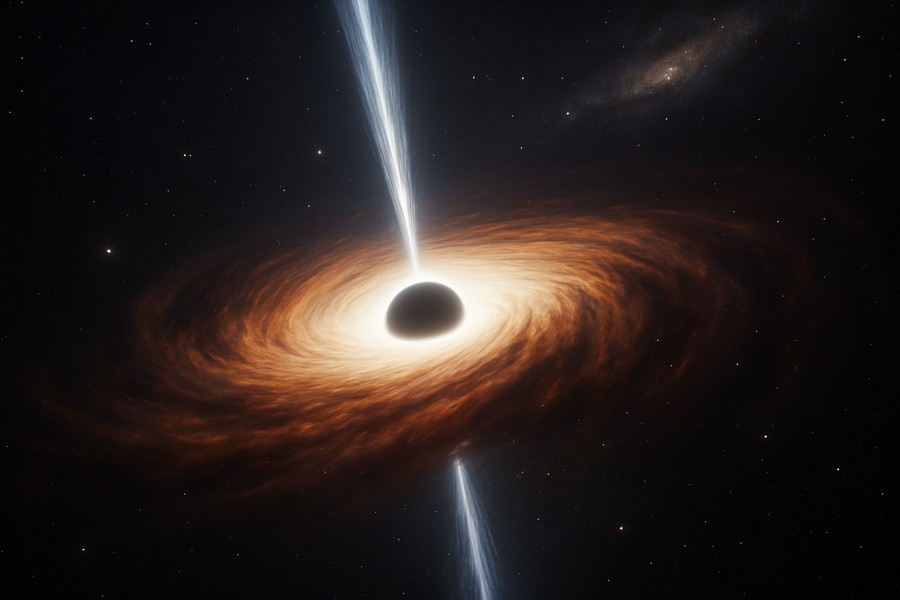
The black hole, an extremely bright and active supermassive black hole, is emitting immense radiation from its poles and X-ray emissions from the infalling material circling its center at nearly the speed of light. It's also incredibly large, with a mass 440 million times that of our sun, when the universe was only 15% of its current age, making it more than 100 times larger than the supermassive black hole at the center of our Milky Way galaxy.
Black Holes and Their Boundaries
Even with their reputation for being the universe's hungriest entities, black holes have a limit to how much they can consume. When they pull in gas and dust, the matter forms a swirling disk around the black hole. As gravity pulls material from this disk into the black hole, the incoming matter creates radiation pressure that pushes back, preventing more material from falling in. This is known as the Eddington limit, a self-regulating system that limits how fast a black hole can grow.
However, it is possible for black holes to temporarily surpass this limit and experience rapid growth spurts, referred to as a super-Eddington limit. There are various theories on how this can occur, one of which suggests that black holes can consume matter faster than the Eddington limit for a short period before the radiation pressure kicks in to regulate the consumption rate.
Super-Eddington Mechanics and SMBH Growth
Super-Eddington mechanics may help explain how supermassive black holes grew so quickly in the early universe, in a time-frame that defies current expectations. Some scientists believe that the first and largest stars in the universe, known as Population III stars, collapsed to form black hole "seeds" that were thousands of times the mass of our sun. However, to reach the size of some observed supermassive black holes, these "seeds" would need to feed at the Eddington limit for over 650 million years, a seemingly impossible task due to the enormous amount of gas required.
Understanding Black Hole Growth
By measuring the brightness of ID830 in ultraviolet and X-ray wavelengths, researchers calculated that it is consuming mass at about 13 times the Eddington limit. This could be due to a sudden increase in inflowing gas after the black hole tore apart and swallowed a celestial body that strayed too close. This level of consumption would require a massive star or a large gas cloud, suggesting that such extreme growth phases may be rare and brief.
Challenging existing theories, ID830 is producing both radio and X-ray emissions, which were not expected to occur together, especially when a black hole is consuming at a super-Eddington rate. This unexpected combination might indicate that we do not yet fully understand the physical mechanisms of extreme accretion and jet launching.
Implications for Early Galaxy Evolution
The unusual behaviors of ID830 could suggest that it is in a rare phase of excessive consumption and radiation. This feeding frenzy has energized both its jets and its corona, causing ID830 to shine brightly across multiple wavelengths as it emits excess radiation.
Furthermore, researchers believe that quasars like ID830 might be more common than previously thought, based on analysis of its UV brightness. While models predict that only around 10% of quasars have spectacular radio jets, these energetic objects might have been significantly more abundant in the early universe than we currently believe.