
Antarctica’s Infamous Glacier Proves a Challenge for Scientists
In a recent setback for climate researchers, one of the world's most hazardous glaciers has proven to be a formidable foe. An array of scientific tools was swallowed up by the ice, thwarting the research project before it could truly get off the ground.
A group of scientists hailing from the United Kingdom and South Korea was striving to set up devices under Antarctica's Thwaites Glacier to better comprehend how the ice was melting from beneath. However, the instruments became stuck in the ice midway through the descent, prematurely ending the research initiative.
"Conducting fieldwork in Antarctica is always fraught with dangers," stated one of the team's oceanographers and drilling engineers. "There's a minuscule window of opportunity wherein everything must align perfectly. Although this result is a bitter pill to swallow, the data we managed to gather is scientifically important and will inform future endeavors."
The Menace of the Doomsday Glacier
The Thwaites Glacier, ominously referred to as the Doomsday Glacier, has the potential to increase global sea levels by up to 25 inches (65 centimeters) if it were to fully collapse. This could result in the flooding of coastal cities and displacement of millions of individuals.
The vast ice structure is largely unstable, with minimal information known about the warming waters flowing beneath it, causing the glacier to melt from below. The scientists and engineers of the recent expedition aimed to evaluate the oceanic conditions beneath the main trunk of the rapidly moving Thwaites Glacier.
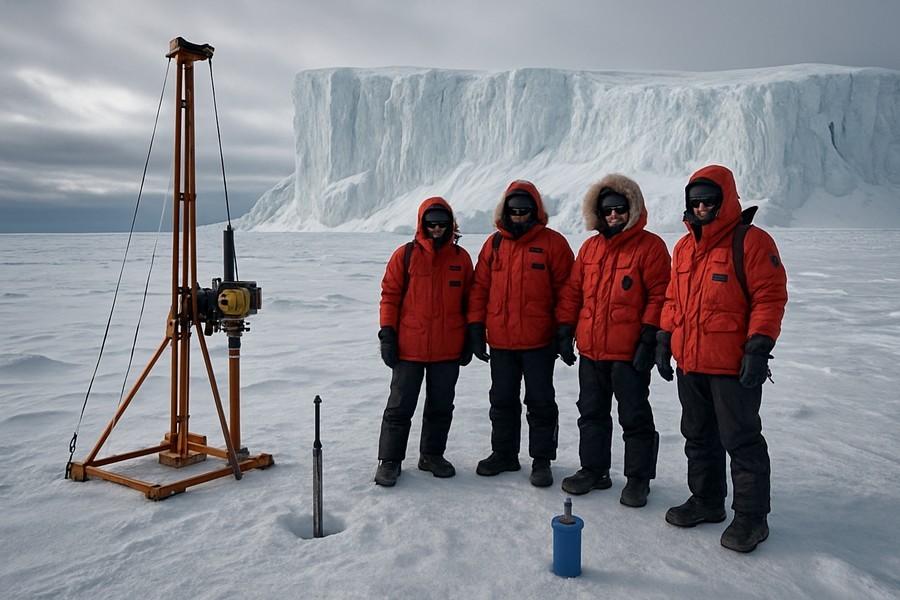
To gain insight into the happenings beneath the glacier, the team employed hot water to drill holes in the ice, enabling them to lower an assortment of instruments to gather data. The drilled hole was roughly 3,300 feet (1,000 meters) deep and close to 11 inches (30 cm) wide, requiring constant maintenance to prevent refreezing.
Unforeseen Challenges
The team momentarily deployed the instruments under the ice, collecting data that indicated turbulent ocean conditions and relatively warm waters capable of melting the glacier from below. They then tried to lower a mooring system into the ice, intended to stay there for one to two years while transmitting data via satellite.
However, the instruments became lodged in the borehole about three-quarters of the way down. It is suspected that this was either due to the water refreezing or the glacier's swift movement.
Unfortunately, the researchers ran out of time to make another attempt, as their return ship to New Zealand was scheduled to depart soon. Faced with a tight schedule and deteriorating weather conditions, they had no choice but to leave the trapped instruments behind.
"Failure is always a possibility when pushing the boundaries of scientific exploration," said another oceanographer and member of the drilling team. "We know that heat beneath Thwaites Glacier is causing ice loss. Even though we're disappointed that the full deployment wasn't achieved, these observations represent an important step forward."
Learning from Past Attempts
This was the team's second attempt to deploy a set of instruments beneath Thwaites Glacier. In a previous attempt in 2022, severe sea-ice conditions prevented the researchers from reaching the site.
This time, they succeeded in piercing the ice and partially lowering the instruments beneath the glacier. Moreover, they managed to procure unprecedented data about the warming waters beneath Thwaites Glacier.
"This isn't the end of the story," stated the expedition's chief scientist and professor from South Korea. "The data indicate that this is exactly the right place to study, despite the challenges. What we've learned here strengthens the case for coming back."