
Revealing the Mysteries of the Universe: A New Look at Dark Energy
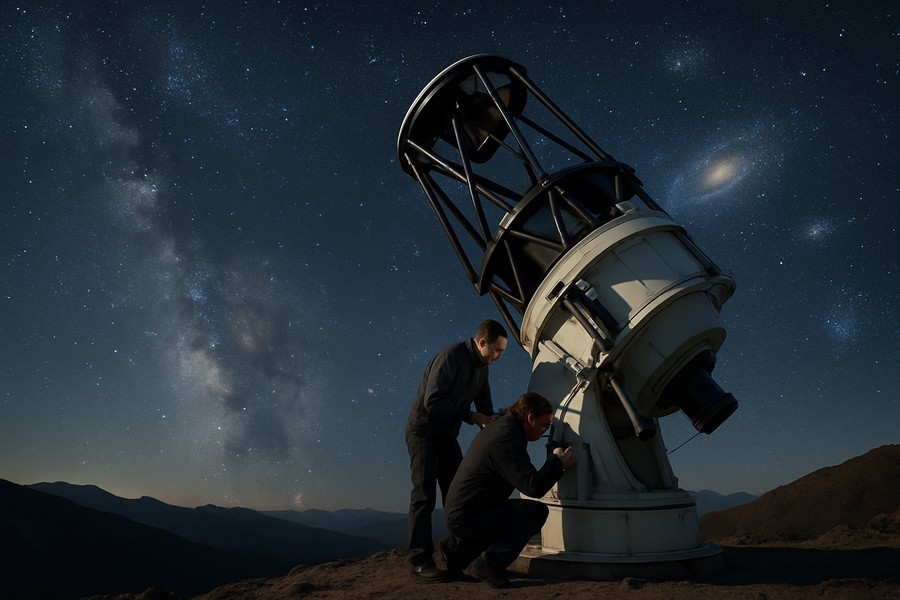
Scientists have made remarkable progress in understanding the universe's expansion and the enigmatic force, dark energy, accelerating this process. They achieved this breakthrough by analyzing data gathered over six years using a high-tech camera mounted on a prominent 4-meter telescope.
This camera has spent 758 nights surveying one-eighth of the sky, gathering information from 669 million galaxies billions of light-years away from our planet. This comprehensive study, conducted between 2013 and 2019, represents a significant step forward in our understanding of the universe.
Combining Four Techniques to Understand Dark Energy
In an unprecedented move, researchers combined four different methods of studying dark energy. This blending of approaches has doubled the restrictions on the impact of dark energy, bringing us closer to defining this dominant and mysterious force in the universe.
"These results provide new insights into our understanding of the universe and its expansion. It shows how investing in long-term research and mixing different types of analysis can shed light on the universe's biggest mysteries," said a top official from the Department of Energy’s Office of Science.
The Expanding Mystery of Dark Energy
Dark energy was first hinted at in 1998 when two separate groups of astronomers observed faraway supernovas moving away from Earth at surprising speeds. This discovery not only confirmed the universe's expansion, a concept suggested by Edwin Hubble a century ago, but also shockingly revealed that this expansion is accelerating.
In the 28 years since this initial discovery, scientists have found that dark energy makes up about 68% of the total energy and matter in the universe. It was also discovered that the effects of dark energy really started to show between 3 and 7 billion years ago, overwhelming the force of gravity on a large scale. These findings have emphasized the need to understand what dark energy really is.
Probing the Universe's Structure and Expansion
The recent study looked at Type-Ia supernovas, the same type used to first discover dark energy, and three other phenomena related to cosmic structure and expansion. These phenomena include weak gravitational lensing, galaxy clustering, and baryon acoustic oscillations, which are density fluctuations in the early universe caused by pressure waves.
"It is an incredible feeling to see these results based on all the data. It feels like a dream come true," said a member of the research team.
Comparing Theories of the Universe
Using the data gathered and the techniques mentioned above, the research team was able to reconstruct the distribution of matter over the last 6 billion years. They then compared these results against two popular models of the universe.
One model, the standard model, assumes that dark energy is stable over time. The other model allows dark energy to evolve over time. The results of the study align well with both models.
However, the study found a discrepancy regarding how matter is predicted to cluster in the modern universe based on measurements of the early universe. This discrepancy suggests that modern galaxies do not cluster as either model predicts, making the difference between observation and theory even more noticeable.
What's Next for Dark Energy Exploration?
The next phase for the research team is to combine the existing data with observations from around 20 billion galaxies from a recently completed observatory. This collaboration will provide an even more detailed image of the universe's history and the nature of dark energy.
"The research has been transformative, and the new observatory will take us even further. Its unprecedented survey of the southern sky will enable new gravity tests and shed more light on dark energy," said the National Science Foundation Program Director.