
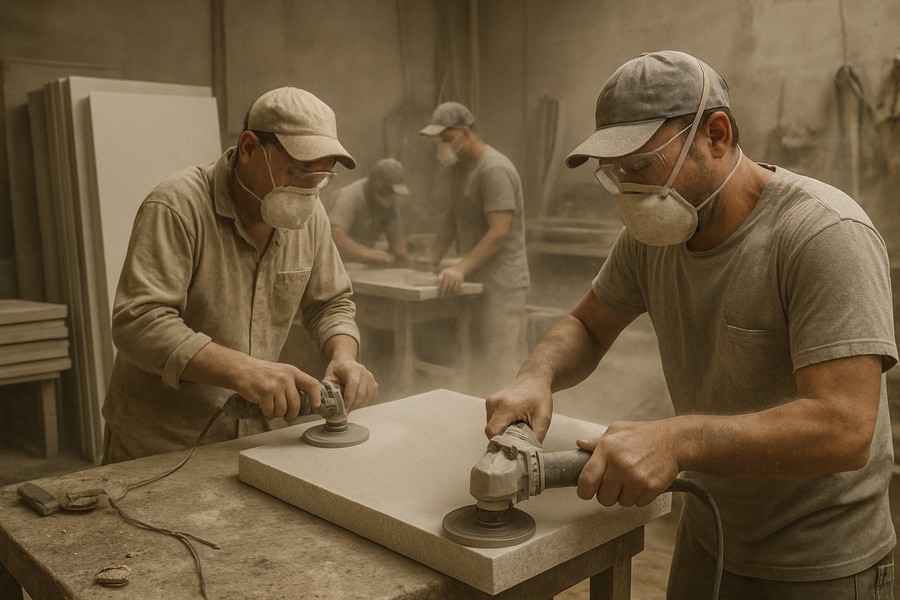
Health Crisis Emerges in Countertop Industry as Workers Suffer from Silicosis
Countertop workers, like 37-year-old César Manuel González, are facing a serious health risk due to their job. González used to work with engineered stone, a material designed to outlive the kitchens it graces. This material, particularly engineered quartz countertops, has become increasingly popular in home renovations not only in the U.S. but globally, generating a market worth around $30 billion.
The Unseen Danger
When González worked, the dust that rose from his saw seemed harmless. It would simply settle on his clothes, hair, and across the floor of his small shop. He initially worked with marble and granite but shifted to engineered stone after the 2008-09 recession when the demand for cheaper quartz countertops grew.
However, the dust from cutting and polishing the engineered stone was not as innocent as it seemed. It contained crystalline silica which deposited in González's lungs, causing irreversible damage. His breathlessness gradually turned into silicosis, a disease that hardens the lungs to the point where even simple movements require effort. His only hope for survival was a lung transplant.
A Growing Epidemic
González's story is not unique. Silicosis, a disease that was once primarily associated with miners, is now becoming prevalent among younger men, often of Hispanic descent, who work in the countertop industry.
In the U.S., cases are emerging in countertop fabrication shops from California to Texas, Florida, and the Northeast. Because silicosis is not a nationally reportable disease and surveillance varies by state, there is no comprehensive national count. However, medical professionals who treat occupational lung disease have noted a sharp rise in cases over the past decade. In California alone, more than 500 confirmed cases have been identified since 2019, with the median age at diagnosis being 46.
The Industry's Response
While there is no debate among doctors that working with engineered stone can lead to lung scarring, manufacturers maintain that with proper ventilation, wet cutting, and the use of respirators, the fabrication process can be safe. However, workers, physicians, and lawyers disagree, arguing that a material composed mostly of crystalline silica may be impossible to handle safely on a large scale.
Over 370 lawsuits have been filed by workers claiming that engineered stone manufacturers failed to warn employees about the risks or sold a product that cannot be fabricated safely. Meanwhile, lawmakers are considering legislation that would largely protect manufacturers from liability in these cases, turning a workplace health crisis into a national debate on regulation, responsibility, and civil litigation.
The Debate Rages On
In the midst of this debate is Gustavo Reyes, a 36-year-old worker who, like González, spent the early years of his career cutting marble and granite before shifting to engineered stone. When Reyes was diagnosed, he did not know what silicosis meant. He was told there was no medication and that he had three to five years to live. He received a lung transplant in 2023. He believes the industries that created the artificial stone are responsible.
However, manufacturers dispute this. Major companies claim engineered stone can be fabricated safely when employers follow OSHA dust controls, including wet cutting, ventilation, and respirator use.
Looking Forward
The disease is not new, having been well known in mining and sandblasting industries, but its recent emergence in the countertop industry is. Engineered stone, often marketed as "quartz", contains very high levels of crystalline silica. According to Dr. Robert Blink, an occupational and environmental medicine specialist, cutting this material "weaponizes the silica", turning it into respirable particles small enough to lodge deep in the lungs, triggering inflammation and fibrosis.
The health crisis has sparked a debate over accountability and regulation. While manufacturers argue that compliance with OSHA silica standard removes the risk, lawyers maintain that the product's composition, not isolated regulatory noncompliance, is the issue. As the debate rages on, workers continue to suffer, their lives forever changed by the dust they inhaled at work.