
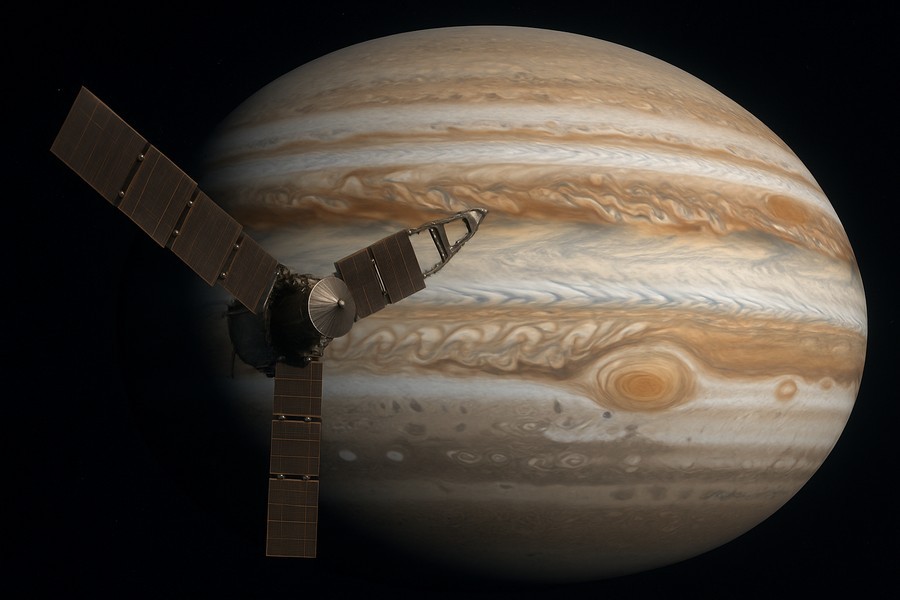
New Findings Reveal Jupiter as Less Bulky and More Compressed
Recent scientific research has debunked long-standing beliefs about Jupiter, indicating that the planet is somewhat smaller and more compressed than previously assumed.
Scientists have used radio data gathered by a spacecraft currently orbiting Jupiter to fine-tune measurements of the planet, which is the largest in our solar system. Although the differences between the new and old measurements aren't massive, they play a crucial role in enhancing our understanding of Jupiter's internal structure and other similar gas giants in the universe.
Time to Revise the Textbooks
One of the study's contributors, a planetary scientist based in Israel, remarked, "The size of Jupiter hasn't changed, of course, but the way we measure it has." He added that "Textbooks will need to be updated" based on the new findings.
Until recently, the understanding of Jupiter's size and form was based on a handful of measurements taken nearly half a century ago by four different space missions. These measurements, performed using radio beams, became the accepted standard.
However, a mission that has been studying Jupiter and its moons since it reached the gas giant in 2016, has managed to gather significantly more radio data over the past two years. With this wealth of additional data, researchers have managed to refine Jupiter's size measurements to an additional accuracy of around 1,300 feet in each direction.
The same scientist explained, "Just by knowing the distance to Jupiter and watching how it rotates, it's possible to figure out its size and shape. But making really accurate measurements calls for more sophisticated methods."
Light-Bending Technique
In their recent study, the researchers monitored how the radio signals from their spacecraft back to Earth bent as they passed through Jupiter's atmosphere. The planet eventually blocked the signal entirely. These measurements enabled the team to account for Jupiter's winds, which subtly alter the planet's shape. They then used this information to make accurate calculations of the planet's shape and size.
With the new data, the team calculated that the distance from Jupiter's pole to its center (the planet's radius) is 41,534 miles, which is 7.5 miles less than what previous measurements showed. The newly calculated radius at the equator is 44,421 miles, which is 2.5 miles less than previously thought.
Significance of the New Measurements
"These few kilometers matter," stated another contributor to the study, an expert on gas giants. "Shifting the radius by just a little lets our models of Jupiter's interior fit both the gravity data and atmospheric measurements much better."
The revised measurements will enhance our understanding of the inside of Jupiter and assist scientists in interpreting data from other gas giants outside our solar system, the researchers noted in their study.
"This research helps us understand how planets form and evolve," said the scientist, adding that "Jupiter was likely the first planet to form in the solar system, and by studying what's happening inside it, we get closer to understanding how the solar system, and planets like ours, came to be."