
Supermassive Black Holes Named After 'Lord of the Rings' Locations Spell Good News for Scientists
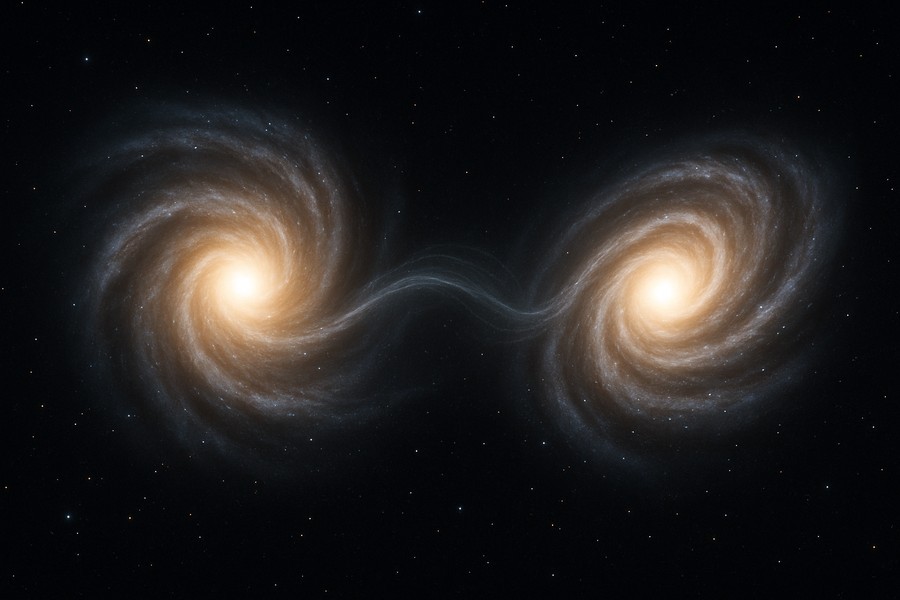
Renowned fantasy saga, 'The Lord of the Rings,' has inspired scientists to name two merging supermassive black holes after its iconic locations - Gondor and Rohan. Unlike the ominous implications in the novel, the lighting up of these cosmic 'beacons' is cause for celebration among the scientific community.
The dynamic duo of black holes, officially coded as SDSS J0729+4008 (Gondor) and SDSS J1536+0411 (Rohan), were identified by a team of astronomers using a groundbreaking technique. This method involves the utilization of the constant hum of space ripples, known as 'gravitational waves,' in partnership with observations of quasars, the powerful engines driven by supermassive black holes that feast on surrounding matter.
Deciphering the Logic Behind These Cosmic Beacons
The reasoning for this technique is quite straightforward. As supermassive black holes approach each other and begin to merge, they emit gravitational waves of increasing frequency. This creates a consistent hum of gravitational waves in the background. Interestingly, these mergers are five times more likely to occur within quasars, making them excellent indicators of merging supermassive black holes.
When the 'beacons' of these quasars light up due to gravitational waves, it is a telltale sign of the presence of binary black holes. This innovative detection technique allows scientists to create a stellar map of these merging cosmic giants, offering new insights into the universe's workings.
Groundbreaking Findings and Their Implications
Chiara Mingarelli, a member of the discovering team, stated, "Our discovery offers the scientific community the first solid benchmarks for developing and testing detection protocols for individual, continuous gravitational wave sources." Indeed, this significant breakthrough sets a new precedent in the study of gravitational waves and black holes.
Mingarelli and her team used their novel approach to search for supermassive black hole binaries in 114 Active Galactic Nuclei (AGNs). These are the bright central regions of galaxies where supermassive black holes voraciously consume surrounding gas and dust.
On a lighter note, Mingarelli explained the choice of names for these black hole systems, stating, "The names come from both people and pop culture. Rohan was first, named after Rohan Shivakumar, the student who first analyzed it. Gondor came next because — the beacons were lit!"
Looking Ahead: The Future of Black Hole Research
The team plans to spend the following months identifying more supermassive black hole binaries. Even a relatively small catalog of these cosmic mergers could assist in creating a comprehensive gravitational wave background map. This research holds potential to enhance scientific understanding of galaxy mergers, black hole physics, and the nature of gravitational waves themselves.
"Our work has laid out a roadmap for a systematic supermassive black hole binary detection framework," Mingarelli said. "We carried out a systematic, targeted search and developed a rigorous protocol. Two targets rose to the top, inspiring further investigation."