
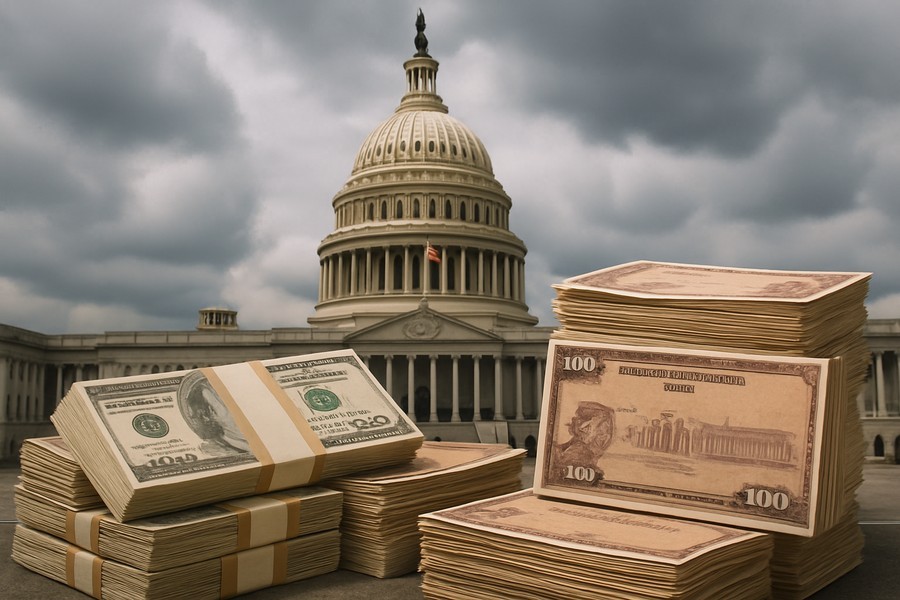
An In-Depth Look at America's Recent Borrowing Practices
The last five months have seen the United States borrowing an astonishing sum of $50 billion each week. A major driver behind this increase in outlays for interest is the fact that the nation's debt has grown since the beginning of the fiscal year, coupled with an increase in long-term interest rates.
Interestingly, despite the massive amounts being borrowed, this data reflects an improvement when compared to the same period during the previous year. In fact, the need for borrowing was higher by a whopping $142 billion from October to February.
Concerns Over the National Debt
Although this slight improvement may be encouraging, it does little to calm those concerned about the state of the country's budget. Concerns are especially high as the interest payments on the debt are predicted to exceed $1 trillion this year and may even surpass $2 trillion by 2036.
Experts are voicing concerns that the current situation is not sustainable in the long run. They urge policymakers to take decisive action to reduce deficits. Aiming for a 3% deficit-to-GDP target is suggested as an effective starting point to get the national debt on a manageable and sustainable path in relation to the economy.
Understanding the Debt-to-GDP Ratio
The total level of debt is not necessarily a cause for alarm among economists. In fact, government debt is considered a necessary part of global markets. However, the key concern lies in the debt-to-GDP ratio, which measures a country's borrowing against its economic growth.
If this ratio leans too heavily towards debt, economic growth can be affected due to the substantial cash needed for interest payments. Although the suggested 3% annual deficit-to-GDP target is not the same as the debt-to-GDP ratio, it is a way to tie government borrowing to the economy's output. In recent times, the deficit-to-GDP figure has hovered between 5% and 6%.
Revenue Increases Offset Higher Spending
The deficit situation in the first five months of FY26 was not improved by a decrease in spending. Instead, the government was able to generate more revenue, which balanced the increase in spending.
Revenue from customs duties increased more than fourfold compared to the same period in the previous year, resulting in an extra $109 billion. Although some of these collected duties will have to be refunded to U.S importers due to a Supreme Court ruling, the revenue loss is expected to be minimal due to newly announced tariffs.
Additionally, the government was able to increase its revenue through income and payroll (social insurance) taxes, which together increased by $132 billion.
Government Spending Increases
Despite the increase in revenue, government spending also saw a significant increase. In the first five months of the year, spending reached $3.1 trillion, which is $64 billion more than the same period in the previous year.
The three major spending programs—social security, Medicare, and Medicaid—saw an increase of $104 billion. The Departments of Defense and Veterans Affairs also had increases in spending, while the Departments of Agriculture, Homeland Security and Education saw decreases. The Environmental Protection Agency reported a $20 billion decrease in outlays, which can be attributed to spending under a clean energy grant program established by a previous act.