
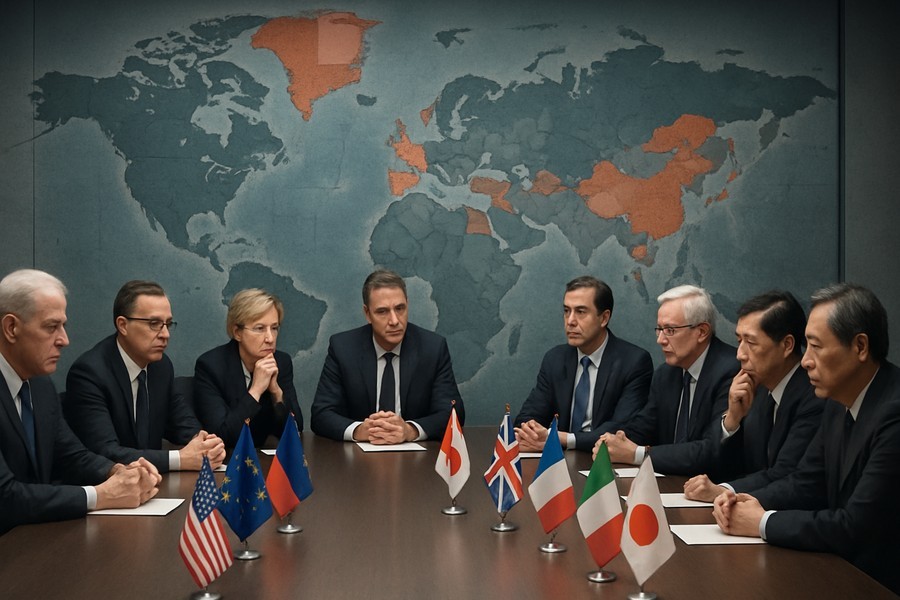
Revamping the Global System: A New Approach
The global order, constructed from the remnants of World War II under President Harry Truman, has witnessed a significant shift. This system was primarily dominated by the United States, with major roles in international organizations such as the United Nations, the World Bank and NATO. The objective of this treaty was to ensure peace and freedom from aggression in the North Atlantic community.
Today, changes are taking shape with a different perspective. A case in point is Greenland, a semiautonomous territory that has been a part of Denmark, a NATO member, for three centuries. Currently, there is a call for US control of Greenland, stirring critical reactions among many foreign policy analysts. However, the insistence on this move aligns with an aggressive and unilateral stance on foreign policy.
Breaking From Tradition
The international order, anchored by the United States for nearly eight decades, has been maintained by both Democratic and Republican presidents. This system, centered around military alliances, free trade, and democracy, has been beneficial for the US and its allies. However, as the world evolves, some of these institutions have not adapted adequately. They are often perceived as burdens, hindering swift and decisive action.
Some argue that this shock therapy was necessary to jolt US allies out of complacency. However, without reassurances, these actions could risk undermining the credibility of these alliances instead of strengthening them.
Foreign Policy Shifts
During his first term, the focus was to keep the US away from foreign conflicts. However, in his second term, military force has become a more common tool. In the past year alone, the US has launched attacks on four Middle Eastern countries and two African countries. Additionally, there have been threats to other nations and the recent removal of Venezuela's President Nicolás Maduro.
However, these interventions have raised questions about their impact on US security, prosperity, and values. In Venezuela, the stance towards the country's opposition, seen by many as the rightful winners of the 2024 presidential election, has been somewhat tepid.
A New Doctrine
While dismantling the 20th-century world order, there seems to be a return to aspects of 19th-century US foreign policy, reminiscent of the Monroe Doctrine. The modern version, dubbed the "Donroe Doctrine", asserts a strong presence in the Western Hemisphere with a message, "This is our hemisphere".
In this term, there's been an increase in aggression towards smaller, weaker states. While this show of strength is said to provide leverage in peace-making, it's been less effective when dealing with more powerful rivals, like Russia and China.
Questioning Reliability
This combative approach has led to a shift in perspective among many US allies, causing them to reconsider their dependence on the US. In the short term, allies are adopting a defensive stance to avoid conflict with the US. However, in the long run, they are seeking ways to decrease reliance on the United States.
There is concern that the US is overestimating its unilateral power and underestimating the value of partnerships. As the old order breaks down, a new version is still emerging, with the contours yet to be fully defined.