
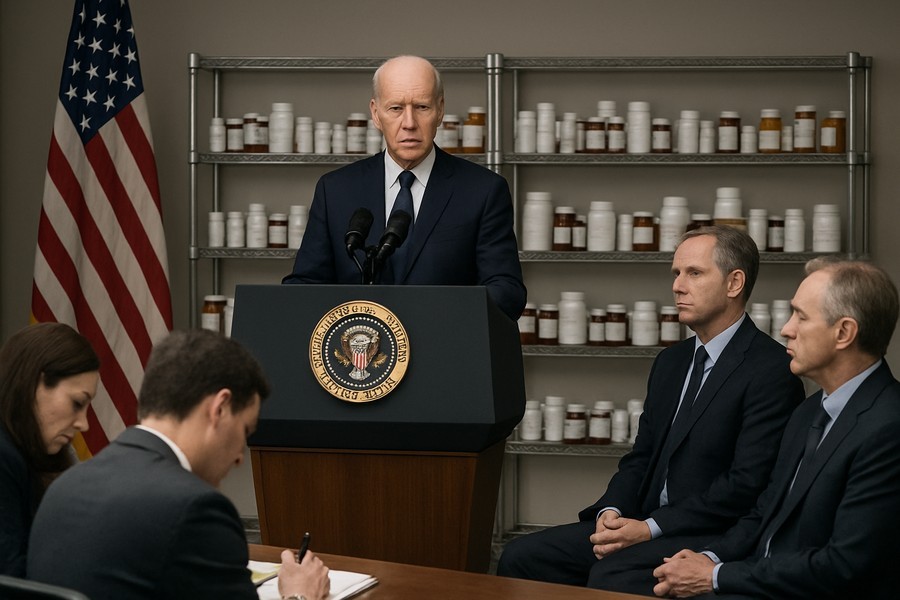
President Announces Tariffs on Certain Pharmaceutical Drugs
The President recently signed an executive order which could potentially implement tariffs of up to 100% on some patented drugs. This action will impact pharmaceutical companies that fail to strike deals with the administration in the near future.
Who Will Be Affected?
Pharmaceutical companies that have agreed to a "most favored nation" pricing deal and are actively constructing facilities within the United States to produce patented pharmaceuticals and their ingredients will be exempt from any tariffs. However, companies that are constructing such facilities in the U.S. but have not agreed to a pricing deal face a 20% tariff. This tariff could escalate to 100% within a four-year period.
Companies have been given a grace period before these tariffs come into effect. Larger companies have 120 days, whilst other companies have 180 days to negotiate terms. Up until now, the administration has successfully reached 17 pricing deals with major pharmaceutical manufacturers, with 13 of these companies officially signing agreements.
Why the Tariffs?
In the executive order, the President stated that this action was necessary "to address the threatened impairment of the national security posed by imports of pharmaceuticals and pharmaceutical ingredients". This announcement comes on the anniversary of the President's controversial "Liberation Day" tax, a sweeping import tax that impacted nearly every country and led to a stock market downturn.
Concerns from Pharmaceuticals Industry
The impending tariffs have raised concerns amongst industry leaders. The CEO of a major pharmaceutical trade group has stated that these taxes could increase costs and potentially threaten billions in U.S. investments. He referred to America's significant role in biopharmaceutical manufacturing and highlighted that many medicines sourced from abroad are primarily from dependable U.S. allies.
Trade Deals and Import Taxes
Since the beginning of his second term, the President has introduced numerous import taxes and has promised that high levies on foreign-made drugs are imminent. However, the threat of new tariffs has also been used as leverage to negotiate deals with significant pharmaceutical companies, under the promise of lower prices for new drugs.
Several countries have also reached trade agreements with the U.S. to limit the tariffs on drugs sent to the U.S. Countries such as the EU, Japan, Korea, and Switzerland will face a 15% U.S. tariff on patented pharmaceuticals. The U.K. is set to have a 10% tariff, which is expected to eventually reduce to zero under future trade agreements.
Updates to Metal Tariffs
In addition to the pharmaceutical tariffs, the President also announced changes to his 50% tariffs on imported steel, aluminum, and copper. Starting next week, tariff rates on these metals will be determined based on the "full customs value" of what U.S. customers pay when purchasing foreign metal.
Products made entirely of steel, aluminum, and copper will continue to be tariffed at 50% for most countries. However, the calculation method for tariffs is being adjusted for derivative metals, which are finished goods that contain some of these metals, but not entirely.
For products where metal makes up less than 15% of its total weight, only country-specific tariffs will now apply. However, for products with a higher metal content, a 25% tariff will apply to the entire value.
Continuation of Sectoral Duties
The latest orders are another example of the President using sectoral duties. The President has cited the 1962 Trade Expansion Act to impose these levies, the same authority he used to impose import taxes on cars, lumber, and even kitchen cabinets. With a recent Supreme Court ruling striking down tariffs imposed under a different law, it's expected that we may see more product-specific import taxes in the future.
Despite a significant blow to the President’s economic agenda with this court decision, there are still numerous options for aggressive import taxation. Beyond sectoral levies, a 10% tariff was imposed on all imports under a separate legal power immediately following the Supreme Court’s ruling. However, that duty can only last for 150 days, and it has already been challenged by nearly two dozen states.