
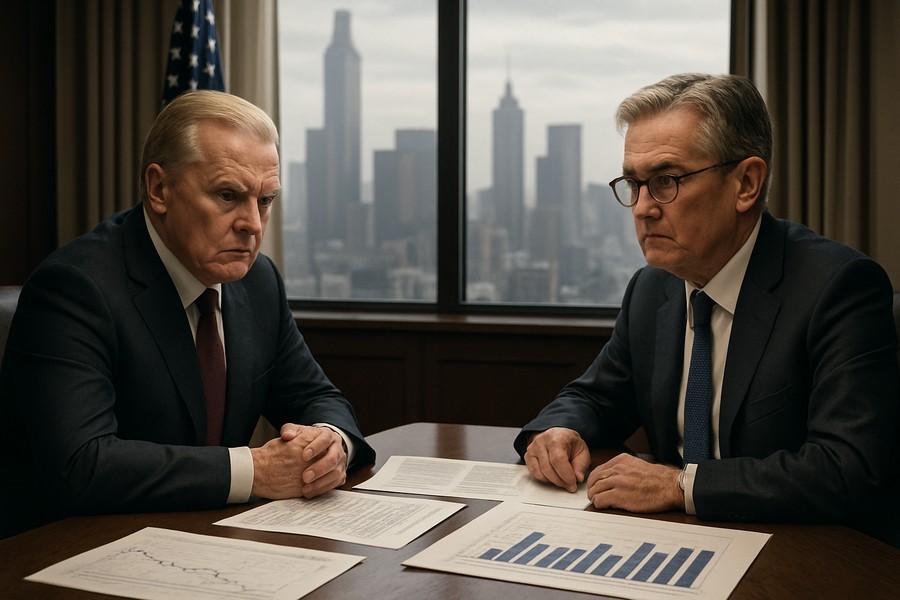
A Power Struggle: Political Leader Versus Central Bank
The ongoing battle between a political leader and a central bank over questionable policy decisions brings to mind a similar situation from a different part of the world. The leader's insistent demands and pushing of legal boundaries mirrors a past incident involving the central bank of another country.
Deja Vu in Financial History
In 2010, the head of a South American country's central bank was removed from his position after he refused to comply with the President's order to tap into the bank's reserves to pay off the nation's debt. He legally contested his dismissal but eventually stepped down due to the unbearable pressure. This conflict is now seen as an early sign of the financial chaos that would later engulf the country, resulting in high inflation and a significant drop in the currency's value from which the country is still recovering.
The current disagreement between a certain political leader and his country's Federal Reserve has sparked discussions about a similar potential future for the United States.
Clashing on Economic Policies
Since resuming power, this leader has been blaming the chair of the Federal Reserve for mishandling the economy and escalating the government's debt burden by keeping interest rates too high. However, his attempts to control the bank don't stop at mere accusations on social media. In a recent controversial move, he attempted to fire a top policymaker, a decision that is now being challenged in the Supreme Court.
Legal Investigations and Market Reactions
The Federal Reserve is also currently under investigation by the Department of Justice over allegations of overspending on property renovations. The bank's chair has dismissed these claims as an excuse. Despite the ongoing drama, the market response has been relatively calm, which experts interpret as a sign of investors' faith in the bank's ability to continue functioning independently.
This trust will be put to the test in the coming weeks, as the Supreme Court is set to hear arguments about the policymaker's dismissal and the leader is expected to announce his choice to replace the current Federal Reserve chair whose term ends soon.
A Global Perspective
Observers from around the world have expressed surprise at the unfolding situation, with some stating that it resembles something more common in emerging markets or unstable countries. A renowned economist criticized this behavior, saying that it's something one might expect in a "banana republic," not in the United States.
The Risk of Inflation
The leader remains unyielding in the face of calls to reduce his interference with the bank, a powerful economic entity with vast financial reserves and the power to influence borrowing costs across an economy. He has dismissed any involvement in the legal investigation and has maintained his right to express his views.
However, economists warn that his persistent attacks could jeopardize the economy. They argue that evidence shows that central banks perform best when free from political pressure. This consensus was reached after painful experiences with inflation in the 1970s, leading to a wave of global reforms. Extensive academic research has since linked central bank independence to lower inflation over time.
Pressure on Central Banks Around the World
Despite the leader's unprecedented pressure on the Federal Reserve, he is not the only head of state to disregard advice to leave central bankers alone. A study of central banks in 118 countries between 2010 and 2018 found that roughly 10% of central banks each year faced pressure from political leaders wanting lower interest rates, which can provide a short-term economic boost. This pressure is most likely to arise in countries with nationalist or populist leaders and is typically followed by higher inflation.
US Fallout
Even if the Federal Reserve became a tool of the president, analysts believe the US economy is unlikely to face as severe a fallout as smaller nations like Argentina and Turkey. However, some say there are already signs the fight is having consequences, pointing to an 8% fall in the value of the dollar against a basket of currencies over the last year.
At the Supreme Court, justices have also indicated that they see the bank as different from other arms of government, where they have let the leader's firings proceed. The Federal Reserve sets interest rates via a committee with 12 members, of whom the president appoints only seven and who each have long, staggered terms, which may help it maintain confidence in its policies.
Still, much of the Federal Reserve's reputation for independence is rooted in convention, rather than legal design. In global comparisons of central bank independence, as measured by legal features, the Federal Reserve ranks in the bottom third.
Observing this fight unfold, many hope that the strength of US institutions will prevail. However, they warn that the leader is taking unnecessary risks and should know better.