
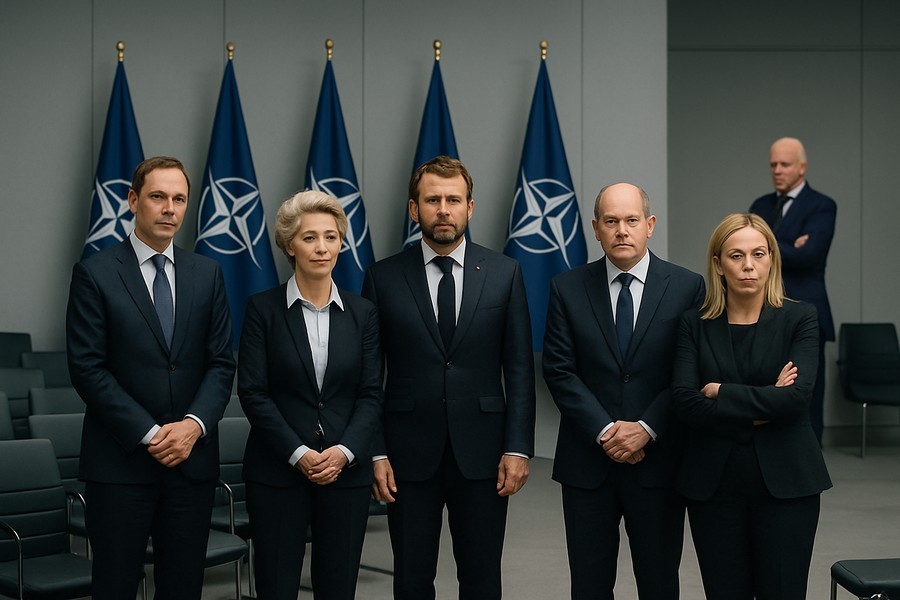
European Allies Stand United Amidst U.S. Pressure
The U.S. president's frustration with European allies for not supporting the war against Iran has ironically brought them closer together, standing united against him. Discussions are ongoing amongst European leaders about how to deal with threats to leave NATO from the U.S., and what the next steps would be if this were to happen.
A Fractured Alliance
Increasingly, European leaders are feeling that the recent attacks on countries such as Britain, Spain, and France by the U.S. president signify a deep rift in the once strong transatlantic alliance. And while the solution isn't clear yet, some nations are already considering bolstering their defense and security structures to compensate for a potentially weakened NATO.
An unnamed European diplomat disclosed that internal NATO operations are currently at a standstill, with meetings unable to take place. The perception that NATO is already deteriorating is shared by others, including an EU official who insists that Europe must strengthen its defenses promptly.
Deepening Crisis
In recent times, the U.S. administration's decisions have thrown the military alliance into a deep crisis, possibly the worst in its long history. The U.S. has stated that they will reevaluate their membership in NATO after the conclusion of the Iran war, as a response to the European allies' refusal to participate in the conflict against Iran.
European Unity in Opposition
The refusal of European powers like Spain, the U.K., and France to allow U.S. forces to utilize their military bases or airspace for operations against Iran has been a significant point of contention for the U.S. Since the war's inception, the U.S. president's dissatisfaction has only grown, as evidenced by numerous posts on his social media account.
For European nations, the priority is to safeguard themselves from the fallout and preserve what's most important to them. The unity among the European nations has been remarkably strong, with leaders standing firm in their refusal to commit military assets to join the American and Israeli bombing efforts in Iran.
Learning from the Past
Unlike the 2003 invasion of Iraq when countries like the U.K. and Poland sent troops to support the American forces, these nations are making it clear that they won't be partaking in the current conflict. Spain and France have also taken decisive steps to limit U.S. military activity within their domains.
Looking Ahead
Despite the ongoing tension, European nations are exploring ways to aid in peacekeeping or policing efforts in the region once the conflict ends. There's hope that diplomatic efforts, such as an upcoming state visit to the U.S. by British royalty, might help mend the strained relationship with the U.S.
NATO's Future
There's a degree of concern among NATO officials regarding the alliance's stability. Moreover, the U.S. hasn't formally requested assistance from NATO, leading to confusion about what exactly is expected from them.
There's a growing sense among Europeans that they need to look for alternatives or strengthen existing structures to guard against the potential downfall of NATO. Several European countries have already started enhancing their defense cooperation mechanisms.
European Defense Initiative
While NATO has been a key component of European security since 1949, recent events have prompted the EU to take a more active role in defense matters. The EU has allocated significant funds for countries to invest in their defenses and is also considering a mutual defense clause in the EU treaty. The aim is to ensure that Europe is prepared for any eventuality.
