
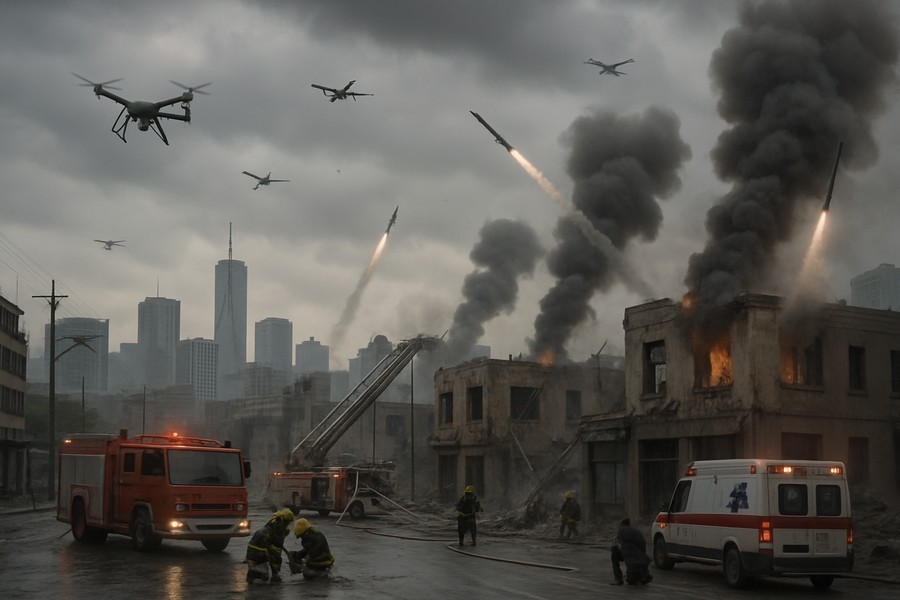
Unprecedented Aerial Attack on Ukraine Following Tripartite Dialogue
In what is being called the largest air raid this year, Ukraine experienced a massive aerial bombardment. This development occurred not long after representatives from Ukraine, Russia, and the United States had a meeting, the first of its kind since the conflict started.
The discussions, which spanned over Friday and Saturday, took place in Abu Dhabi, UAE, and have since concluded, as announced by the Ukrainian team. The specifics of what transpired during the negotiations are not yet known.
Impact of the Aerial Strike
As the meetings were taking place, Ukraine's capital was targeted by missiles and drone strikes, prompting the activation of air defenses. The attack resulted in casualties, with one fatality and four injuries reported. The mayor of Kyiv, Vitali Klitschko, elaborated on the aftermath of the raid, stating that the falling debris triggered fires and damaged structures. He added that nearly 6,000 apartment blocks were deprived of heating, and certain areas of the city experienced water supply disruption. The temperature in Kyiv was recorded as -12 degrees Celsius (10 degrees Fahrenheit) in the morning following the attack.
Kyiv was not the only city under fire. Kharkiv, Ukraine's second-largest city, was also targeted. The strikes caused damage to a maternity hospital and a dormitory housing displaced individuals. The city's mayor, Ihor Terekhov, confirmed that these attacks resulted in 19 injuries, including one child.
Extent of the Aerial Assault
Ukraine's President Volodymyr Zelensky, in a statement, revealed that more than 370 drones and 21 missiles were deployed in the overnight attack. Other cities targeted included Sumy and Chernihiv. He also mentioned that the focus of these attacks was Ukraine's energy sector, a critical component, especially during the harsh winter.
This aggressive action came shortly after the conclusion of the first day of discussions between the representatives of the involved countries.
Sticking Point in the Negotiations
The area of territory remains the primary unresolved issue in the talks. Russia has consistently maintained that Ukraine should withdraw from the Donbas region in the eastern part of the country, a proposition that Ukraine has persistently refused.
The Donbas region is comprised of the Donetsk and Luhansk coal-rich areas that previously made up Ukraine's industrial hub. This region houses a significant Russian-speaking populace. It is also the region where Putin's mission to destabilize and control Ukraine began in 2014.
This region is crucial as it includes a "fortress belt" of industrial cities, railways, and roads that serve as the backbone of Ukraine's defense and supply the frontline. The loss of this region would expose the rest of eastern Ukraine.
Representatives at the Talks
Representatives from all three countries attended the talks in Abu Dhabi. Russia sent a military team, including a top spy and military intelligence chief; Ukraine was represented by top negotiators, including diplomats and security officials; and the US had representatives from the previous administration.
The previous US administration urged Ukraine to accept a peace deal, despite concerns that such an agreement could favor Moscow.
Despite the conflict which started four years ago, Russia still occupies approximately 20% of the territory acknowledged under international law as part of sovereign Ukraine. This includes almost all of the Luhansk region, and parts of the Donetsk, Kherson, and Zaporizhzhia regions.
Following the conclusion of Friday's discussions, Ukraine's top negotiator expressed gratitude to the US for mediating and stated that the meeting was centered on achieving a "dignified and lasting peace." However, President Zelensky maintained a careful stance, declaring that it was still "too early" to make conclusions from the talks.